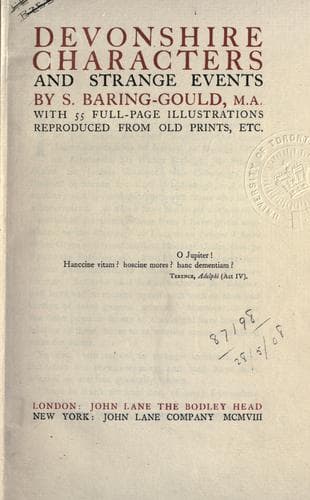
Devonshire Characters and Strange EventsBaring-Gould, S. (Sabine)
History
Devonshire Characters and Strange Events
Baring-Gould, S. (Sabine)
Devon (England) -- Biography; Devon (England) -- History
It is possible enough that Savery had read the suggestions of the
Marquess of Worcester, and that this ingenious author gave him the
first hint whither to turn to find the force required. But how he was
led to steam is differently stated.
Desaguliers says that Savery’s own account was this: Having drunk a
flask of Florence at a tavern, and thrown the bottle into the fire,
he proceeded to wash his hands, when he noticed that the little wine
left in the flask was converted into steam. He took the vessel by the
neck and plunged its mouth into the water in the basin, when, the steam
being condensed, the water was immediately driven up into the bottle by
the atmospheric pressure.
Switzer, however, who was very intimate with Savery, gives another
account. He says that the first hint from which he took the engine was
from a tobacco-pipe, which he immersed in water to wash or cool it.
Then he noticed how that by the rarefaction of the air in the tube by
the heat, the gravitation or pressure of the external air, upon the
condensation of the steam, made the water to spring through the tube of
the pipe in a most surprising manner.
However it was that Savery obtained his first idea of the expansion and
condensation of steam and of atmospheric pressure, he had now before
him a new and untried power with which to deal, and he was obliged to
approach it by several tentative efforts.
Before 1696 he had constructed several steam pumping engines to mines
in Cornwall, and he described these as already working in his book
entitled _The Miners’ Friend_.[24] He took with him a model to London
and exhibited it to William III in 1698, and the King promoted Savery’s
application for a patent, which was secured in July, 1698, and an Act
was passed confirming it in the ensuing year.
Papin saw Savery’s steam engine, when exhibited before the Royal
Society, he also witnessed the trial of his paddle-boat on the Thames.
Returning to Marburg, of which university he was professor, he thought
over what he had seen, and it occurred to him to combine the two
contrivances in one, and to apply Savery’s motive power in the pump to
drive Savery’s paddle-wheels. But it took him fifteen years to fit up
a boat that worked to his satisfaction. “It is important,” he wrote to
Liebnitz on 7 July, 1707, “that my new construction of vessel should be
put to the proof in a seaport like London, where there is depth enough
to apply the new invention, which, by means of fire, will render one or
two men capable of producing more effect than some hundreds of rowers.”
Papin’s boat that he intended to send to London was destroyed by some
watermen, who feared the new invention might interfere with their trade.
Public-domain text, read in full here on John Shaqi.
Reviews
Reviews
No reviews yet
Be the first to share your thoughts on this work.
Elsewhere in the archive
Join the Discussion
Join the discussion
Sign in to leave a comment or review.
Sign InorCreate an account