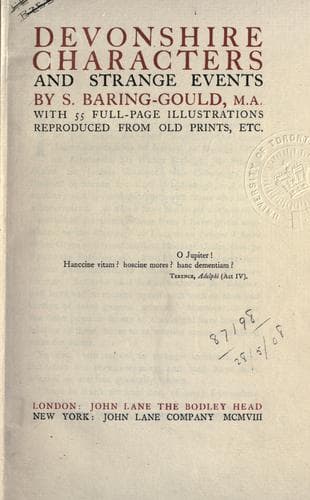
Devonshire Characters and Strange EventsBaring-Gould, S. (Sabine)
History
Devonshire Characters and Strange Events
Baring-Gould, S. (Sabine)
Devon (England) -- Biography; Devon (England) -- History
Although of gentle blood, Thomas Newcomen, son of Elias, and the
inventor, was a tradesman in Dartmouth, variously described as a
locksmith, an ironmonger, and a blacksmith; and probably combining all
these trades. He lived in a picturesque gabled house, with overhanging
stories sustained by carved-oak corbels, in Lower Street. As the
street was very narrow, it was taken down by order of the Local Board,
in 1864, and Mr. Thomas Lidstone became the purchaser of the most
interesting portions of the old dwelling. These he afterwards erected
in a new building for himself, which he called Newcomen Cottage. This
Mr. Lidstone was greatly interested in the history of Newcomen, and in
1871 published _A Few Notes and Queries about Newcomen_, and in 1876
_Notes on the Model of Newcomen’s Steam Engine_ (1705).
For some time Thomas Newcomen carried on his experiments in secret on
the leads of his house. A letter extant of the time is quoted by Mr.
Lidstone.
“When [Newcomen] was engaged on his great work, which took him three
years from its commencement until it was completed, and was kept a
profound secret, some of his friends would press Mrs. Newcomen to find
out what her husband was engaged about, and, ‘for their part, they
would not be satisfied to be kept in ignorance.’ Mrs. Newcomen replied,
‘I am perfectly easy. Mr. Newcomen cannot be employed about anything
wrong; and I am fully persuaded, when he thinks proper, he will,
himself, unasked, inform me.’”
When Thomas Newcomen had perfected his engine he associated with
himself Calley or Cawley, a Dartmouth brazier, and How, another
Dartmouth man, in applying for a patent.
Newcomen was a man of reading, and was in correspondence with Dr.
Hooke, secretary of the Royal Society. There are to be found among
Hooke’s papers, in the possession of the Royal Society, some notes
of observations made by him for the use of Newcomen on Papin’s
boasted method of transmitting to a great distance the action of a
mill by means of pipes. Papin’s project was to employ the mill to
work two air pumps of great diameter. The cylinders of these pumps
were to communicate by means of pipes with equal cylinders furnished
with pistons in the neighbourhood of a mine. The pistons were to
be connected by means of levers with the piston-rods of the mine.
Therefore, when the piston of the air pumps at the mill was drawn up by
the engine the corresponding piston at the side of the mine would be
pressed down by the atmosphere, and thus would raise the piston-rod in
the mine and throw up the water. It would appear from these notes that
Dr. Hooke dissuaded Newcomen from erecting a machine on this principle,
of which he saw the fallacy.
Public-domain text, read in full here on John Shaqi.
Reviews
Reviews
No reviews yet
Be the first to share your thoughts on this work.
Elsewhere in the archive
Join the Discussion
Join the discussion
Sign in to leave a comment or review.
Sign InorCreate an account