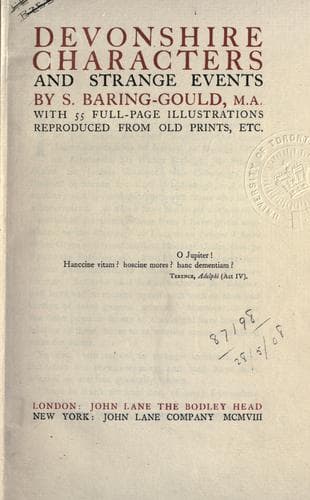
Devonshire Characters and Strange EventsBaring-Gould, S. (Sabine)
History
Devonshire Characters and Strange Events
Baring-Gould, S. (Sabine)
Devon (England) -- Biography; Devon (England) -- History
It is highly probable that, in the course of his labours and
speculations, it occurred to Newcomen that the vacuum he so much
desired to create might be produced by steam, and that this gave rise
to his new principle, and the construction of his steam engine. He saw
the defects of Savery’s engine, and laboured to correct them. Savery,
however, claimed the invention as his own, which lay at the root of
Newcomen’s improvements; and Newcomen, being a Quaker, and averse from
contention, and moreover glad to be assisted by Savery’s wide circle of
acquaintances, was content to share the honours and the profits with
Savery.
Switzer, who knew both, says: “Mr. Newcomen was as early in his
invention as Mr. Savery was in his; only, the latter being nearer the
Court, had obtained the patent before the other knew it, on which
account Mr. Newcomen was glad to come in as a partner to it.”[26]
[Illustration: _The STEAM ENGINE near Dudley Castle. Invented by_ Capt.
Savery. & M^r. Newcomen Erected by y^e later. 1712 _delin. & Sculp by
T^t Barney 1719._
_Reproduced by kind permission of Messrs. Macmillan & Co._]
Savery had created his vacuum by the condensation of steam in a closed
vessel by dashing cold water against it. Papin had created his vacuum
by exhausting the air in a cylinder, fitted with a piston, by means of
an air pump. What Newcomen did was to combine both systems. Instead
of employing Savery’s closed vessel, he made use of Papin’s cylinder
fitted with a piston, but worked by the condensation of steam, still
employing the clumsy system of dashing cold water against the cylinder.
Whilst the engine was still in its trial state an accident occurred
that led to another change in the mode of condensation. It was this. In
order to keep the cylinder as free from air as possible, great pains
were taken to prevent it from passing down with the piston, and to keep
the cylinder air-tight, water was employed to lie above the place where
the piston passed up or down.
At one of the early trials the inventors were surprised to see the
engine make several rapid strokes, and on looking into the cause found
that there was a small hole in the piston, which allowed a jet of cold
water to penetrate within, and that this acted as a rapid condenser of
the steam.
A new light suddenly broke upon Newcomen. The idea of condensing the
steam, and so producing a vacuum by injecting cold water into the
receiver, instead of splashing it against the outside, at once occurred
to him; and he proceeded to embody the principle which this accident
had suggested, as part of his machine.
Another improvement was due to another accident, if so it may be
termed. To keep the machine in action a man or boy had to be employed
in turning alternately two taps, one admitting the steam into the
cylinder, the other admitting the cold jet into it to condense it.
Public-domain text, read in full here on John Shaqi.
Reviews
Reviews
No reviews yet
Be the first to share your thoughts on this work.
Elsewhere in the archive
Join the Discussion
Join the discussion
Sign in to leave a comment or review.
Sign InorCreate an account