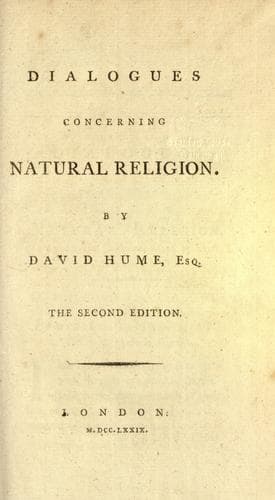
Dialogues Concerning Natural Religion — John Shaqi
Dialogues Concerning Natural ReligionHume, David
ReligionComparative
Dialogues Concerning Natural Religion
Hume, David
Natural theology -- Early works to 1800; Religion -- Early works to 1800
What I chiefly scruple in this subject, said PHILO, is not so much that
all religious arguments are by CLEANTHES reduced to experience, as that
they appear not to be even the most certain and irrefragable of that
inferior kind. That a stone will fall, that fire will burn, that the
earth has solidity, we have observed a thousand and a thousand times; and
when any new instance of this nature is presented, we draw without
hesitation the accustomed inference. The exact similarity of the cases
gives us a perfect assurance of a similar event; and a stronger evidence
is never desired nor sought after. But wherever you depart, in the least,
from the similarity of the cases, you diminish proportionably the
evidence; and may at last bring it to a very weak analogy, which is
confessedly liable to error and uncertainty. After having experienced the
circulation of the blood in human creatures, we make no doubt that it
takes place in TITIUS and MAEVIUS. But from its circulation in frogs and
fishes, it is only a presumption, though a strong one, from analogy, that
it takes place in men and other animals. The analogical reasoning is much
weaker, when we infer the circulation of the sap in vegetables from our
experience that the blood circulates in animals; and those, who hastily
followed that imperfect analogy, are found, by more accurate experiments,
to have been mistaken.
If we see a house, CLEANTHES, we conclude, with the greatest certainty,
that it had an architect or builder; because this is precisely that
species of effect which we have experienced to proceed from that species
of cause. But surely you will not affirm, that the universe bears such a
resemblance to a house, that we can with the same certainty infer a
similar cause, or that the analogy is here entire and perfect. The
dissimilitude is so striking, that the utmost you can here pretend to is
a guess, a conjecture, a presumption concerning a similar cause; and how
that pretension will be received in the world, I leave you to consider.
It would surely be very ill received, replied CLEANTHES; and I should be
deservedly blamed and detested, did I allow, that the proofs of a Deity
amounted to no more than a guess or conjecture. But is the whole
adjustment of means to ends in a house and in the universe so slight a
resemblance? The economy of final causes? The order, proportion, and
arrangement of every part? Steps of a stair are plainly contrived, that
human legs may use them in mounting; and this inference is certain and
infallible. Human legs are also contrived for walking and mounting; and
this inference, I allow, is not altogether so certain, because of the
dissimilarity which you remark; but does it, therefore, deserve the name
only of presumption or conjecture?
Public-domain text, read in full here on John Shaqi.
Reviews
Reviews
No reviews yet
Be the first to share your thoughts on this work.
Join the Discussion
Join the discussion
Sign in to leave a comment or review.
Sign InorCreate an account