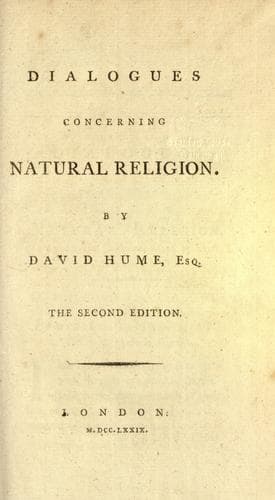
Dialogues Concerning Natural Religion — John Shaqi
Dialogues Concerning Natural ReligionHume, David
ReligionComparative
Dialogues Concerning Natural Religion
Hume, David
Natural theology -- Early works to 1800; Religion -- Early works to 1800
Now, according to this method of reasoning, DEMEA, it follows, (and is,
indeed, tacitly allowed by CLEANTHES himself,) that order, arrangement,
or the adjustment of final causes, is not of itself any proof of design;
but only so far as it has been experienced to proceed from that
principle. For aught we can know a priori, matter may contain the source
or spring of order originally within itself, as well as mind does; and
there is no more difficulty in conceiving, that the several elements,
from an internal unknown cause, may fall into the most exquisite
arrangement, than to conceive that their ideas, in the great universal
mind, from a like internal unknown cause, fall into that arrangement. The
equal possibility of both these suppositions is allowed. But, by
experience, we find, (according to CLEANTHES), that there is a difference
between them. Throw several pieces of steel together, without shape or
form; they will never arrange themselves so as to compose a watch. Stone,
and mortar, and wood, without an architect, never erect a house. But the
ideas in a human mind, we see, by an unknown, inexplicable economy,
arrange themselves so as to form the plan of a watch or house.
Experience, therefore, proves, that there is an original principle of
order in mind, not in matter. From similar effects we infer similar
causes. The adjustment of means to ends is alike in the universe, as in a
machine of human contrivance. The causes, therefore, must be resembling.
I was from the beginning scandalised, I must own, with this resemblance,
which is asserted, between the Deity and human creatures; and must
conceive it to imply such a degradation of the Supreme Being as no sound
Theist could endure. With your assistance, therefore, DEMEA, I shall
endeavour to defend what you justly call the adorable mysteriousness of
the Divine Nature, and shall refute this reasoning of CLEANTHES, provided
he allows that I have made a fair representation of it.
When CLEANTHES had assented, PHILO, after a short pause, proceeded in the
following manner.
Public-domain text, read in full here on John Shaqi.
Reviews
Reviews
No reviews yet
Be the first to share your thoughts on this work.
Join the Discussion
Join the discussion
Sign in to leave a comment or review.
Sign InorCreate an account