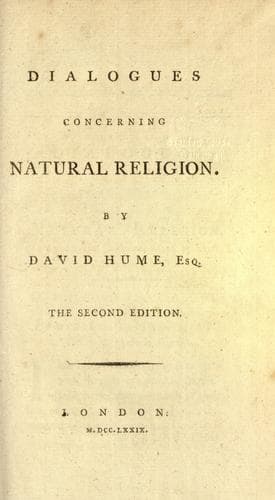
Dialogues Concerning Natural Religion — John Shaqi
Dialogues Concerning Natural ReligionHume, David
ReligionComparative
Dialogues Concerning Natural Religion
Hume, David
Natural theology -- Early works to 1800; Religion -- Early works to 1800
After I joined the company, whom I found sitting in CLEANTHES's library,
DEMEA paid CLEANTHES some compliments on the great care which he took of
my education, and on his unwearied perseverance and constancy in all his
friendships. The father of PAMPHILUS, said he, was your intimate friend:
The son is your pupil; and may indeed be regarded as your adopted son,
were we to judge by the pains which you bestow in conveying to him every
useful branch of literature and science. You are no more wanting, I am
persuaded, in prudence, than in industry. I shall, therefore, communicate
to you a maxim, which I have observed with regard to my own children,
that I may learn how far it agrees with your practice. The method I
follow in their education is founded on the saying of an ancient, "That
students of philosophy ought first to learn logics, then ethics, next
physics, last of all the nature of the gods." [Chrysippus apud Plut: de
repug: Stoicorum] This science of natural theology, according to him,
being the most profound and abstruse of any, required the maturest
judgement in its students; and none but a mind enriched with all the other
sciences, can safely be entrusted with it.
Are you so late, says PHILO, in teaching your children the principles of
religion? Is there no danger of their neglecting, or rejecting altogether
those opinions of which they have heard so little during the whole course
of their education? It is only as a science, replied DEMEA, subjected to
human reasoning and disputation, that I postpone the study of Natural
Theology. To season their minds with early piety, is my chief care; and
by continual precept and instruction, and I hope too by example, I
imprint deeply on their tender minds an habitual reverence for all the
principles of religion. While they pass through every other science, I
still remark the uncertainty of each part; the eternal disputations of
men; the obscurity of all philosophy; and the strange, ridiculous
conclusions, which some of the greatest geniuses have derived from the
principles of mere human reason. Having thus tamed their mind to a proper
submission and self-diffidence, I have no longer any scruple of opening
to them the greatest mysteries of religion; nor apprehend any danger from
that assuming arrogance of philosophy, which may lead them to reject the
most established doctrines and opinions.
Public-domain text, read in full here on John Shaqi.
Reviews
Reviews
No reviews yet
Be the first to share your thoughts on this work.
Join the Discussion
Join the discussion
Sign in to leave a comment or review.
Sign InorCreate an account