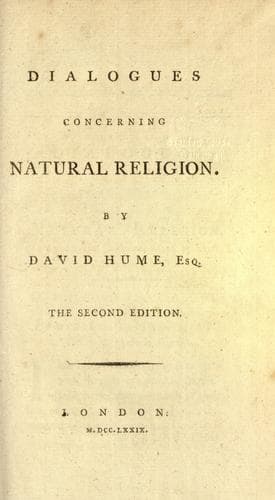
Natural theology -- Early works to 1800; Religion -- Early works to 1800
Our friend CLEANTHES, replied PHILO, as you have heard, asserts, that
since no question of fact can be proved otherwise than by experience, the
existence of a Deity admits not of proof from any other medium. The
world, says he, resembles the works of human contrivance; therefore its
cause must also resemble that of the other. Here we may remark, that the
operation of one very small part of nature, to wit man, upon another very
small part, to wit that inanimate matter lying within his reach, is the
rule by which CLEANTHES judges of the origin of the whole; and he
measures objects, so widely disproportioned, by the same individual
standard. But to waive all objections drawn from this topic, I affirm,
that there are other parts of the universe (besides the machines of human
invention) which bear still a greater resemblance to the fabric of the
world, and which, therefore, afford a better conjecture concerning the
universal origin of this system. These parts are animals and vegetables.
The world plainly resembles more an animal or a vegetable, than it does a
watch or a knitting-loom. Its cause, therefore, it is more probable,
resembles the cause of the former. The cause of the former is generation
or vegetation. The cause, therefore, of the world, we may infer to be
something similar or analogous to generation or vegetation.
But how is it conceivable, said DEMEA, that the world can arise from any
thing similar to vegetation or generation?
Very easily, replied PHILO. In like manner as a tree sheds its seed into
the neighbouring fields, and produces other trees; so the great
vegetable, the world, or this planetary system, produces within itself
certain seeds, which, being scattered into the surrounding chaos,
vegetate into new worlds. A comet, for instance, is the seed of a world;
and after it has been fully ripened, by passing from sun to sun, and star
to star, it is at last tossed into the unformed elements which every
where surround this universe, and immediately sprouts up into a new
system.
Or if, for the sake of variety (for I see no other advantage), we should
suppose this world to be an animal; a comet is the egg of this animal:
and in like manner as an ostrich lays its egg in the sand, which, without
any further care, hatches the egg, and produces a new animal; so...
I understand you, says DEMEA: But what wild, arbitrary suppositions are
these! What data have you for such extraordinary conclusions? And is the
slight, imaginary resemblance of the world to a vegetable or an animal
sufficient to establish the same inference with regard to both? Objects,
which are in general so widely different, ought they to be a standard for
each other?
Public-domain text, read in full here on John Shaqi.
Reviews
Reviews
No reviews yet
Be the first to share your thoughts on this work.
Join the Discussion
Join the discussion
Sign in to leave a comment or review.
Sign InorCreate an account