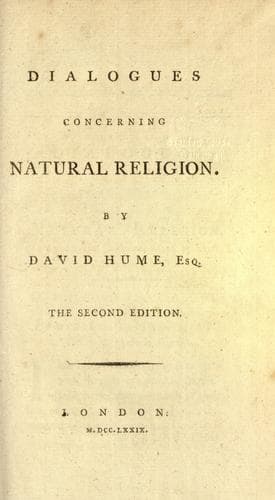
Natural theology -- Early works to 1800; Religion -- Early works to 1800
What you ascribe to the fertility of my invention, replied PHILO, is
entirely owing to the nature of the subject. In subjects adapted to the
narrow compass of human reason, there is commonly but one determination,
which carries probability or conviction with it; and to a man of sound
judgement, all other suppositions, but that one, appear entirely absurd
and chimerical. But in such questions as the present, a hundred
contradictory views may preserve a kind of imperfect analogy; and
invention has here full scope to exert itself. Without any great effort
of thought, I believe that I could, in an instant, propose other systems
of cosmogony, which would have some faint appearance of truth, though it
is a thousand, a million to one, if either yours or any one of mine be
the true system.
For instance, what if I should revive the old EPICUREAN hypothesis? This
is commonly, and I believe justly, esteemed the most absurd system that
has yet been proposed; yet I know not whether, with a few alterations, it
might not be brought to bear a faint appearance of probability. Instead
of supposing matter infinite, as EPICURUS did, let us suppose it finite.
A finite number of particles is only susceptible of finite transpositions:
and it must happen, in an eternal duration, that every possible order or
position must be tried an infinite number of times. This world, therefore,
with all its events, even the most minute, has before been produced and
destroyed, and will again be produced and destroyed, without any bounds
and limitations. No one, who has a conception of the powers of infinite,
in comparison of finite, will ever scruple this determination.
But this supposes, said DEMEA, that matter can acquire motion, without
any voluntary agent or first mover.
And where is the difficulty, replied PHILO, of that supposition? Every
event, before experience, is equally difficult and incomprehensible; and
every event, after experience, is equally easy and intelligible. Motion,
in many instances, from gravity, from elasticity, from electricity,
begins in matter, without any known voluntary agent: and to suppose
always, in these cases, an unknown voluntary agent, is mere hypothesis;
and hypothesis attended with no advantages. The beginning of motion in
matter itself is as conceivable a priori as its communication from mind
and intelligence.
Besides, why may not motion have been propagated by impulse through all
eternity, and the same stock of it, or nearly the same, be still upheld
in the universe? As much is lost by the composition of motion, as much is
gained by its resolution. And whatever the causes are, the fact is
certain, that matter is, and always has been, in continual agitation, as
far as human experience or tradition reaches. There is not probably, at
present, in the whole universe, one particle of matter at absolute rest.
Public-domain text, read in full here on John Shaqi.
Reviews
Reviews
No reviews yet
Be the first to share your thoughts on this work.
Join the Discussion
Join the discussion
Sign in to leave a comment or review.
Sign InorCreate an account