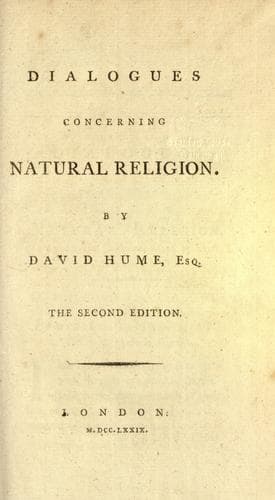
Natural theology -- Early works to 1800; Religion -- Early works to 1800
Suppose (for we shall endeavour to vary the expression), that matter were
thrown into any position, by a blind, unguided force; it is evident that
this first position must, in all probability, be the most confused and
most disorderly imaginable, without any resemblance to those works of
human contrivance, which, along with a symmetry of parts, discover an
adjustment of means to ends, and a tendency to self-preservation. If the
actuating force cease after this operation, matter must remain for ever
in disorder, and continue an immense chaos, without any proportion or
activity. But suppose that the actuating force, whatever it be, still
continues in matter, this first position will immediately give place to a
second, which will likewise in all probability be as disorderly as the
first, and so on through many successions of changes and revolutions. No
particular order or position ever continues a moment unaltered. The
original force, still remaining in activity, gives a perpetual
restlessness to matter. Every possible situation is produced, and
instantly destroyed. If a glimpse or dawn of order appears for a moment,
it is instantly hurried away, and confounded, by that never-ceasing force
which actuates every part of matter.
Thus the universe goes on for many ages in a continued succession of
chaos and disorder. But is it not possible that it may settle at last, so
as not to lose its motion and active force (for that we have supposed
inherent in it), yet so as to preserve an uniformity of appearance,
amidst the continual motion and fluctuation of its parts? This we find to
be the case with the universe at present. Every individual is perpetually
changing, and every part of every individual; and yet the whole remains,
in appearance, the same. May we not hope for such a position, or rather
be assured of it, from the eternal revolutions of unguided matter; and
may not this account for all the appearing wisdom and contrivance which
is in the universe? Let us contemplate the subject a little, and we shall
find, that this adjustment, if attained by matter of a seeming stability
in the forms, with a real and perpetual revolution or motion of parts,
affords a plausible, if not a true solution of the difficulty.
It is in vain, therefore, to insist upon the uses of the parts in animals
or vegetables, and their curious adjustment to each other. I would fain
know, how an animal could subsist, unless its parts were so adjusted? Do
we not find, that it immediately perishes whenever this adjustment
ceases, and that its matter corrupting tries some new form? It happens
indeed, that the parts of the world are so well adjusted, that some
regular form immediately lays claim to this corrupted matter: and if it
were not so, could the world subsist? Must it not dissolve as well as the
animal, and pass through new positions and situations, till in great, but
finite succession, it falls at last into the present or some such order?
Public-domain text, read in full here on John Shaqi.
Reviews
Reviews
No reviews yet
Be the first to share your thoughts on this work.
Join the Discussion
Join the discussion
Sign in to leave a comment or review.
Sign InorCreate an account