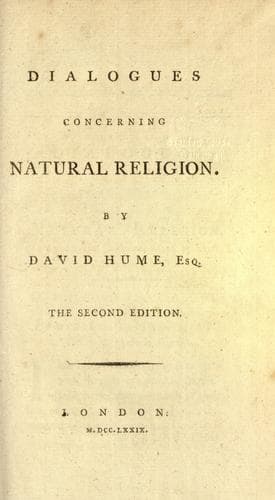
Natural theology -- Early works to 1800; Religion -- Early works to 1800
But allowing you what never will be believed, at least what you never
possibly can prove, that animal, or at least human happiness, in this
life, exceeds its misery, you have yet done nothing: For this is not, by
any means, what we expect from infinite power, infinite wisdom, and
infinite goodness. Why is there any misery at all in the world? Not by
chance surely. From some cause then. Is it from the intention of the
Deity? But he is perfectly benevolent. Is it contrary to his intention?
But he is almighty. Nothing can shake the solidity of this reasoning, so
short, so clear, so decisive; except we assert, that these subjects
exceed all human capacity, and that our common measures of truth and
falsehood are not applicable to them; a topic which I have all along
insisted on, but which you have, from the beginning, rejected with scorn
and indignation.
But I will be contented to retire still from this entrenchment, for I
deny that you can ever force me in it. I will allow, that pain or misery
in man is compatible with infinite power and goodness in the Deity, even
in your sense of these attributes: What are you advanced by all these
concessions? A mere possible compatibility is not sufficient. You must
prove these pure, unmixed, and uncontrollable attributes from the present
mixed and confused phenomena, and from these alone. A hopeful
undertaking! Were the phenomena ever so pure and unmixed, yet being
finite, they would be insufficient for that purpose. How much more, where
they are also so jarring and discordant!
Here, CLEANTHES, I find myself at ease in my argument. Here I triumph.
Formerly, when we argued concerning the natural attributes of
intelligence and design, I needed all my sceptical and metaphysical
subtlety to elude your grasp. In many views of the universe, and of its
parts, particularly the latter, the beauty and fitness of final causes
strike us with such irresistible force, that all objections appear (what
I believe they really are) mere cavils and sophisms; nor can we then
imagine how it was ever possible for us to repose any weight on them. But
there is no view of human life, or of the condition of mankind, from
which, without the greatest violence, we can infer the moral attributes,
or learn that infinite benevolence, conjoined with infinite power and
infinite wisdom, which we must discover by the eyes of faith alone. It is
your turn now to tug the labouring oar, and to support your philosophical
subtleties against the dictates of plain reason and experience.
PART 11
Public-domain text, read in full here on John Shaqi.
Reviews
Reviews
No reviews yet
Be the first to share your thoughts on this work.
Join the Discussion
Join the discussion
Sign in to leave a comment or review.
Sign InorCreate an account