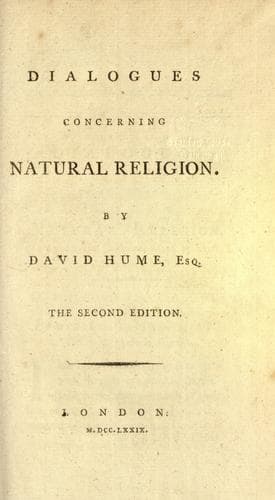
Natural theology -- Early works to 1800; Religion -- Early works to 1800
I scruple not to allow, said CLEANTHES, that I have been apt to suspect
the frequent repetition of the word infinite, which we meet with in all
theological writers, to savour more of panegyric than of philosophy; and
that any purposes of reasoning, and even of religion, would be better
served, were we to rest contented with more accurate and more moderate
expressions. The terms, admirable, excellent, superlatively great, wise,
and holy; these sufficiently fill the imaginations of men; and any thing
beyond, besides that it leads into absurdities, has no influence on the
affections or sentiments. Thus, in the present subject, if we abandon all
human analogy, as seems your intention, DEMEA, I am afraid we abandon all
religion, and retain no conception of the great object of our adoration.
If we preserve human analogy, we must for ever find it impossible to
reconcile any mixture of evil in the universe with infinite attributes;
much less can we ever prove the latter from the former. But supposing the
Author of Nature to be finitely perfect, though far exceeding mankind, a
satisfactory account may then be given of natural and moral evil, and
every untoward phenomenon be explained and adjusted. A less evil may then
be chosen, in order to avoid a greater; inconveniences be submitted to,
in order to reach a desirable end; and in a word, benevolence, regulated
by wisdom, and limited by necessity, may produce just such a world as the
present. You, PHILO, who are so prompt at starting views, and
reflections, and analogies, I would gladly hear, at length, without
interruption, your opinion of this new theory; and if it deserve our
attention, we may afterwards, at more leisure, reduce it into form.
Public-domain text, read in full here on John Shaqi.
Reviews
Reviews
No reviews yet
Be the first to share your thoughts on this work.
Join the Discussion
Join the discussion
Sign in to leave a comment or review.
Sign InorCreate an account