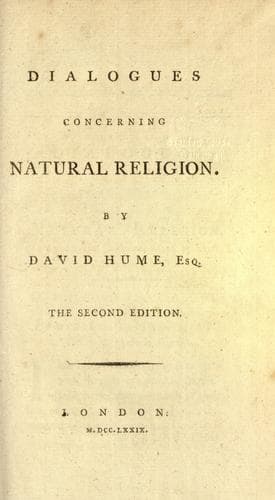
Natural theology -- Early works to 1800; Religion -- Early works to 1800
The fourth circumstance, whence arises the misery and ill of the
universe, is the inaccurate workmanship of all the springs and principles
of the great machine of nature. It must be acknowledged, that there are
few parts of the universe, which seem not to serve some purpose, and
whose removal would not produce a visible defect and disorder in the
whole. The parts hang all together; nor can one be touched without
affecting the rest, in a greater or less degree. But at the same time, it
must be observed, that none of these parts or principles, however useful,
are so accurately adjusted, as to keep precisely within those bounds in
which their utility consists; but they are, all of them, apt, on every
occasion, to run into the one extreme or the other. One would imagine,
that this grand production had not received the last hand of the maker;
so little finished is every part, and so coarse are the strokes with
which it is executed. Thus, the winds are requisite to convey the vapours
along the surface of the globe, and to assist men in navigation: but how
oft, rising up to tempests and hurricanes, do they become pernicious?
Rains are necessary to nourish all the plants and animals of the earth:
but how often are they defective? how often excessive? Heat is requisite
to all life and vegetation; but is not always found in the due
proportion. On the mixture and secretion of the humours and juices of the
body depend the health and prosperity of the animal: but the parts
perform not regularly their proper function. What more useful than all
the passions of the mind, ambition, vanity, love, anger? But how oft do
they break their bounds, and cause the greatest convulsions in society?
There is nothing so advantageous in the universe, but what frequently
becomes pernicious, by its excess or defect; nor has Nature guarded, with
the requisite accuracy, against all disorder or confusion. The
irregularity is never perhaps so great as to destroy any species; but is
often sufficient to involve the individuals in ruin and misery.
Public-domain text, read in full here on John Shaqi.
Reviews
Reviews
No reviews yet
Be the first to share your thoughts on this work.
Elsewhere in the archive
Join the Discussion
Join the discussion
Sign in to leave a comment or review.
Sign InorCreate an account