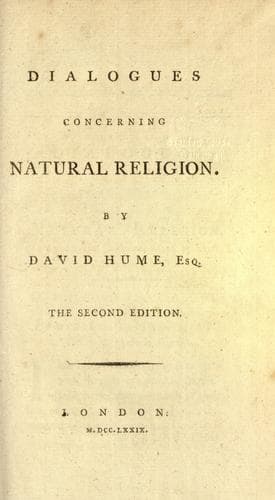
Natural theology -- Early works to 1800; Religion -- Early works to 1800
On the concurrence, then, of these four circumstances, does all or the
greatest part of natural evil depend. Were all living creatures incapable
of pain, or were the world administered by particular volitions, evil
never could have found access into the universe: and were animals endowed
with a large stock of powers and faculties, beyond what strict necessity
requires; or were the several springs and principles of the universe so
accurately framed as to preserve always the just temperament and medium;
there must have been very little ill in comparison of what we feel at
present. What then shall we pronounce on this occasion? Shall we say that
these circumstances are not necessary, and that they might easily have
been altered in the contrivance of the universe? This decision seems too
presumptuous for creatures so blind and ignorant. Let us be more modest
in our conclusions. Let us allow, that, if the goodness of the Deity (I
mean a goodness like the human) could be established on any tolerable
reasons a priori, these phenomena, however untoward, would not be
sufficient to subvert that principle; but might easily, in some unknown
manner, be reconcilable to it. But let us still assert, that as this
goodness is not antecedently established, but must be inferred from the
phenomena, there can be no grounds for such an inference, while there are
so many ills in the universe, and while these ills might so easily have
been remedied, as far as human understanding can be allowed to judge on
such a subject. I am Sceptic enough to allow, that the bad appearances,
notwithstanding all my reasonings, may be compatible with such attributes
as you suppose; but surely they can never prove these attributes. Such a
conclusion cannot result from Scepticism, but must arise from the
phenomena, and from our confidence in the reasonings which we deduce from
these phenomena.
Look round this universe. What an immense profusion of beings, animated
and organised, sensible and active! You admire this prodigious variety
and fecundity. But inspect a little more narrowly these living
existences, the only beings worth regarding. How hostile and destructive
to each other! How insufficient all of them for their own happiness! How
contemptible or odious to the spectator! The whole presents nothing but
the idea of a blind Nature, impregnated by a great vivifying principle,
and pouring forth from her lap, without discernment or parental care, her
maimed and abortive children!
Public-domain text, read in full here on John Shaqi.
Reviews
Reviews
No reviews yet
Be the first to share your thoughts on this work.
Elsewhere in the archive
Join the Discussion
Join the discussion
Sign in to leave a comment or review.
Sign InorCreate an account