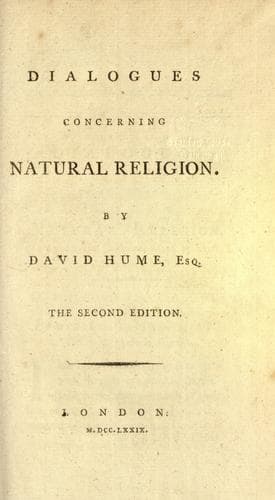
Natural theology -- Early works to 1800; Religion -- Early works to 1800
Here the MANICHAEAN system occurs as a proper hypothesis to solve the
difficulty: and no doubt, in some respects, it is very specious, and has
more probability than the common hypothesis, by giving a plausible
account of the strange mixture of good and ill which appears in life. But
if we consider, on the other hand, the perfect uniformity and agreement
of the parts of the universe, we shall not discover in it any marks of
the combat of a malevolent with a benevolent being. There is indeed an
opposition of pains and pleasures in the feelings of sensible creatures:
but are not all the operations of Nature carried on by an opposition of
principles, of hot and cold, moist and dry, light and heavy? The true
conclusion is, that the original Source of all things is entirely
indifferent to all these principles; and has no more regard to good above
ill, than to heat above cold, or to drought above moisture, or to light
above heavy.
There may four hypotheses be framed concerning the first causes of the
universe: that they are endowed with perfect goodness; that they have
perfect malice; that they are opposite, and have both goodness and
malice; that they have neither goodness nor malice. Mixed phenomena can
never prove the two former unmixed principles; and the uniformity and
steadiness of general laws seem to oppose the third. The fourth,
therefore, seems by far the most probable.
What I have said concerning natural evil will apply to moral, with little
or no variation; and we have no more reason to infer, that the rectitude
of the Supreme Being resembles human rectitude, than that his benevolence
resembles the human. Nay, it will be thought, that we have still greater
cause to exclude from him moral sentiments, such as we feel them; since
moral evil, in the opinion of many, is much more predominant above moral
good than natural evil above natural good.
But even though this should not be allowed, and though the virtue which
is in mankind should be acknowledged much superior to the vice, yet so
long as there is any vice at all in the universe, it will very much
puzzle you Anthropomorphites, how to account for it. You must assign a
cause for it, without having recourse to the first cause. But as every
effect must have a cause, and that cause another, you must either carry
on the progression in infinitum, or rest on that original principle, who
is the ultimate cause of all things...
Hold! hold! cried DEMEA: Whither does your imagination hurry you? I
joined in alliance with you, in order to prove the incomprehensible
nature of the Divine Being, and refute the principles of CLEANTHES, who
would measure every thing by human rule and standard. But I now find you
running into all the topics of the greatest libertines and infidels, and
betraying that holy cause which you seemingly espoused. Are you secretly,
then, a more dangerous enemy than CLEANTHES himself?
Public-domain text, read in full here on John Shaqi.
Reviews
Reviews
No reviews yet
Be the first to share your thoughts on this work.
Elsewhere in the archive
Join the Discussion
Join the discussion
Sign in to leave a comment or review.
Sign InorCreate an account