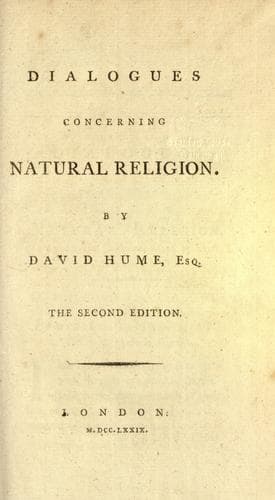
Natural theology -- Early works to 1800; Religion -- Early works to 1800
It is with pleasure I hear GALEN reason concerning the structure of the
human body. The anatomy of a man, says he [De formatione foetus], discovers
above 600 different muscles; and whoever duly considers these, will find,
that, in each of them, Nature must have adjusted at least ten different
circumstances, in order to attain the end which she proposed; proper
figure, just magnitude, right disposition of the several ends, upper and
lower position of the whole, the due insertion of the several nerves,
veins, and arteries: So that, in the muscles alone, above 6000 several
views and intentions must have been formed and executed. The bones he
calculates to be 284: The distinct purposes aimed at in the structure of
each, above forty. What a prodigious display of artifice, even in these
simple and homogeneous parts! But if we consider the skin, ligaments,
vessels, glandules, humours, the several limbs and members of the body;
how must our astonishment rise upon us, in proportion to the number and
intricacy of the parts so artificially adjusted! The further we advance
in these researches, we discover new scenes of art and wisdom: But descry
still, at a distance, further scenes beyond our reach; in the fine
internal structure of the parts, in the economy of the brain, in the
fabric of the seminal vessels. All these artifices are repeated in every
different species of animal, with wonderful variety, and with exact
propriety, suited to the different intentions of Nature in framing each
species. And if the infidelity of GALEN, even when these natural sciences
were still imperfect, could not withstand such striking appearances, to
what pitch of pertinacious obstinacy must a philosopher in this age have
attained, who can now doubt of a Supreme Intelligence!
Could I meet with one of this species (who, I thank God, are very rare),
I would ask him: Supposing there were a God, who did not discover himself
immediately to our senses, were it possible for him to give stronger
proofs of his existence, than what appear on the whole face of Nature?
What indeed could such a Divine Being do, but copy the present economy of
things; render many of his artifices so plain, that no stupidity could
mistake them; afford glimpses of still greater artifices, which
demonstrate his prodigious superiority above our narrow apprehensions;
and conceal altogether a great many from such imperfect creatures? Now,
according to all rules of just reasoning, every fact must pass for
undisputed, when it is supported by all the arguments which its nature
admits of; even though these arguments be not, in themselves, very
numerous or forcible: How much more, in the present case, where no human
imagination can compute their number, and no understanding estimate their
cogency!
Public-domain text, read in full here on John Shaqi.
Reviews
Reviews
No reviews yet
Be the first to share your thoughts on this work.
Elsewhere in the archive
Join the Discussion
Join the discussion
Sign in to leave a comment or review.
Sign InorCreate an account