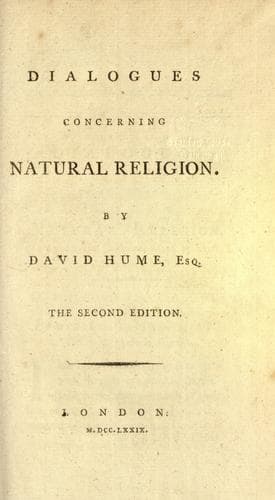
Natural theology -- Early works to 1800; Religion -- Early works to 1800
I shall further add, said CLEANTHES, to what you have so well urged, that
one great advantage of the principle of Theism, is, that it is the only
system of cosmogony which can be rendered intelligible and complete, and
yet can throughout preserve a strong analogy to what we every day see and
experience in the world. The comparison of the universe to a machine of
human contrivance, is so obvious and natural, and is justified by so many
instances of order and design in Nature, that it must immediately strike
all unprejudiced apprehensions, and procure universal approbation.
Whoever attempts to weaken this theory, cannot pretend to succeed by
establishing in its place any other that is precise and determinate: It
is sufficient for him if he start doubts and difficulties; and by remote
and abstract views of things, reach that suspense of judgement, which is
here the utmost boundary of his wishes. But, besides that this state of
mind is in itself unsatisfactory, it can never be steadily maintained
against such striking appearances as continually engage us into the
religious hypothesis. A false, absurd system, human nature, from the
force of prejudice, is capable of adhering to with obstinacy and
perseverance: But no system at all, in opposition to a theory supported
by strong and obvious reason, by natural propensity, and by early
education, I think it absolutely impossible to maintain or defend.
So little, replied PHILO, do I esteem this suspense of judgement in the
present case to be possible, that I am apt to suspect there enters
somewhat of a dispute of words into this controversy, more than is
usually imagined. That the works of Nature bear a great analogy to the
productions of art, is evident; and according to all the rules of good
reasoning, we ought to infer, if we argue at all concerning them, that
their causes have a proportional analogy. But as there are also
considerable differences, we have reason to suppose a proportional
difference in the causes; and in particular, ought to attribute a much
higher degree of power and energy to the supreme cause, than any we have
ever observed in mankind. Here then the existence of a DEITY is plainly
ascertained by reason: and if we make it a question, whether, on account
of these analogies, we can properly call him a mind or intelligence,
notwithstanding the vast difference which may reasonably be supposed
between him and human minds; what is this but a mere verbal controversy?
No man can deny the analogies between the effects: To restrain ourselves
from inquiring concerning the causes is scarcely possible. From this
inquiry, the legitimate conclusion is, that the causes have also an
analogy: And if we are not contented with calling the first and supreme
cause a GOD or DEITY, but desire to vary the expression; what can we call
him but MIND or THOUGHT, to which he is justly supposed to bear a
considerable resemblance?
Public-domain text, read in full here on John Shaqi.
Reviews
Reviews
No reviews yet
Be the first to share your thoughts on this work.
Elsewhere in the archive
Join the Discussion
Join the discussion
Sign in to leave a comment or review.
Sign InorCreate an account