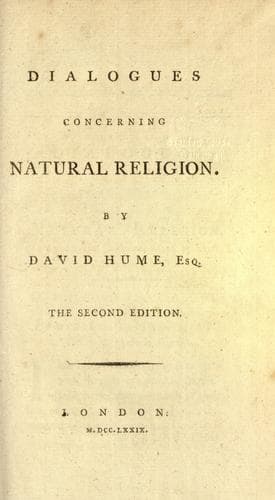
Natural theology -- Early works to 1800; Religion -- Early works to 1800
Oaths are requisite in all courts of judicature; but it is a question
whether their authority arises from any popular religion. It is the
solemnity and importance of the occasion, the regard to reputation, and
the reflecting on the general interests of society, which are the chief
restraints upon mankind. Custom-house oaths and political oaths are but
little regarded even by some who pretend to principles of honesty and
religion; and a Quaker's asseveration is with us justly put upon the same
footing with the oath of any other person. I know, that POLYBIUS
[Lib. vi. cap. 54.] ascribes the infamy of GREEK faith to the prevalency of
the EPICUREAN philosophy: but I know also, that Punic faith had as bad a
reputation in ancient times as Irish evidence has in modern; though we
cannot account for these vulgar observations by the same reason. Not to
mention that Greek faith was infamous before the rise of the Epicurean
philosophy; and EURIPIDES [Iphigenia in Tauride], in a passage which I
shall point out to you, has glanced a remarkable stroke of satire against
his nation, with regard to this circumstance.
Take care, PHILO, replied CLEANTHES, take care: push not matters too far:
allow not your zeal against false religion to undermine your veneration
for the true. Forfeit not this principle, the chief, the only great
comfort in life; and our principal support amidst all the attacks of
adverse fortune. The most agreeable reflection, which it is possible for
human imagination to suggest, is that of genuine Theism, which represents
us as the workmanship of a Being perfectly good, wise, and powerful; who
created us for happiness; and who, having implanted in us immeasurable
desires of good, will prolong our existence to all eternity, and will
transfer us into an infinite variety of scenes, in order to satisfy those
desires, and render our felicity complete and durable. Next to such a
Being himself (if the comparison be allowed), the happiest lot which we
can imagine, is that of being under his guardianship and protection.
These appearances, said PHILO, are most engaging and alluring; and with
regard to the true philosopher, they are more than appearances. But it
happens here, as in the former case, that, with regard to the greater
part of mankind, the appearances are deceitful, and that the terrors of
religion commonly prevail above its comforts.
It is allowed, that men never have recourse to devotion so readily as
when dejected with grief or depressed with sickness. Is not this a proof,
that the religious spirit is not so nearly allied to joy as to sorrow?
Public-domain text, read in full here on John Shaqi.
Reviews
Reviews
No reviews yet
Be the first to share your thoughts on this work.
Elsewhere in the archive
Join the Discussion
Join the discussion
Sign in to leave a comment or review.
Sign InorCreate an account