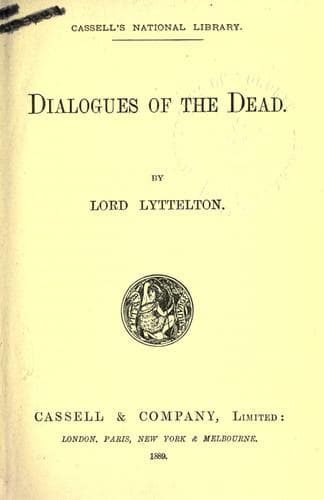
Dialogues of the DeadLyttelton, George Lyttelton, Baron
Philosophy
Dialogues of the Dead
Lyttelton, George Lyttelton, Baron
Dialogues, English -- Early works to 1800; Imaginary conversations
_Bayle_.--The mind is free, and it loves to exert its freedom. Any
restraint upon it is a violence done to its nature, and a tyranny against
which it has a right to rebel.
_Locke_.--The mind, though free, has a governor within itself, which may
and ought to limit the exercise of its freedom. That governor is reason.
_Bayle_.--Yes; but reason, like other governors, has a policy more
dependent upon uncertain caprice than upon any fixed laws. And if that
reason which rules my mind or yours has happened to set up a favourite
notion, it not only submits implicitly to it, but desires that the same
respect should be paid to it by all the rest of mankind. Now I hold that
any man may lawfully oppose this desire in another; and that if he is
wise, he will do his utmost endeavours to check it in himself.
_Locke_.--Is there not also a weakness of a contrary nature to this you
are now ridiculing? Do we not often take a pleasure to show our own
power and gratify our own pride by degrading notions set up by other men
and generally respected?
_Bayle_.--I believe we do; and by this means it often happens that if one
man builds and consecrates a temple to folly, another pulls it down.
_Locke_.--Do you think it beneficial to human society to have all temples
pulled down?
_Bayle_.--I cannot say that I do.
_Locke_.--Yet I find not in your writings any mark of distinction to show
us which you mean to save.
_Bayle_.--A true philosopher, like an impartial historian, must be of no
sect.
_Locke_.--Is there no medium between the blind zeal of a sectary and a
total indifference to all religion?
_Bayle_.--With regard to morality I was not indifferent.
_Locke_.--How could you, then, be indifferent with regard to the
sanctions religion gives to morality? How could you publish what tends
so directly and apparently to weaken in mankind the belief of those
sanctions? Was not this sacrificing the great interests of virtue to the
little motives of vanity?
_Bayle_.--A man may act indiscreetly, but he cannot do wrong, by
declaring that which, on a full discussion of the question, he sincerely
thinks to be true.
Public-domain text, read in full here on John Shaqi.
Reviews
Reviews
No reviews yet
Be the first to share your thoughts on this work.
Elsewhere in the archive
Join the Discussion
Join the discussion
Sign in to leave a comment or review.
Sign InorCreate an account