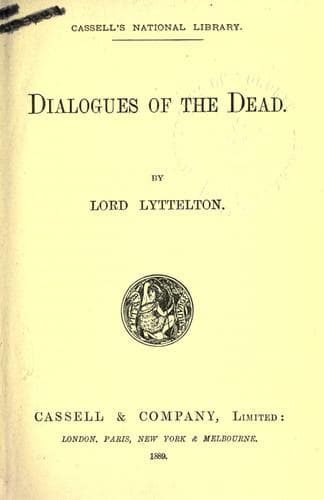
Dialogues of the DeadLyttelton, George Lyttelton, Baron
Philosophy
Dialogues of the Dead
Lyttelton, George Lyttelton, Baron
Dialogues, English -- Early works to 1800; Imaginary conversations
_Locke_.--Opinions taken up without a patient investigation, depending on
terms not accurately defined, and principles begged without proof, like
theories to explain the phenomena of Nature built on suppositions instead
of experiments, must perpetually change and destroy one another. But
some opinions there are, even in matters not obvious to the common sense
of mankind, which the mind has received on such rational grounds of
assent that they are as immovable as the pillars of heaven, or (to speak
philosophically) as the great laws of Nature, by which, under God, the
universe is sustained. Can you seriously think that because the
hypothesis of your countryman Descartes, which was nothing but an
ingenious, well-imagined romance, has been lately exploded, the system of
Newton, which is built on experiments and geometry--the two most certain
methods of discovering truth--will ever fail? Or that, because the whims
of fanatics and the divinity of the schoolmen cannot now be supported,
the doctrines of that religion which I, the declared enemy of all
enthusiasm and false reasoning, firmly believed and maintained, will ever
be shaken?
_Bayle_.--If you had asked Descartes, while he was in the height of his
vogue, whether his system would be ever confuted by any other
philosopher's, as that of Aristotle had been by his, what answer do you
suppose he would have returned?
_Locke_.--Come, come, Monsieur Bayle, you yourself know the difference
between the foundations on which the credit of those systems and that of
Newton is placed. Your scepticism is more affected than real. You found
it a shorter way to a great reputation (the only wish of your heart) to
object than to defend, to pull down than to set up. And your talents
were admirable for that kind of work. Then your huddling together in a
critical dictionary a pleasant tale, or obscene jest, and a grave
argument against the Christian religion, a witty confutation of some
absurd author, and an artful sophism to impeach some respectable truth,
was particularly commodious to all our young smarts and smatterers in
freethinking. But what mischief have you not done to human society! You
have endeavoured, and with some degree of success, to shake those
foundations on which the whole moral world and the great fabric of social
happiness entirely rest. How could you, as a philosopher, in the sober
hours of reflection, answer for this to your conscience, even supposing
you had doubts of the truth of a system which gives to virtue its
sweetest hopes, to impenitent vice its greatest fears, and to true
penitence its best consolations; which restrains even the least
approaches to guilt, and yet makes those allowances for the infirmities
of our nature which the stoic pride denied to it, but which its real
imperfection and the goodness of its infinitely benevolent Creator so
evidently require?
Public-domain text, read in full here on John Shaqi.
Reviews
Reviews
No reviews yet
Be the first to share your thoughts on this work.
Elsewhere in the archive
Join the Discussion
Join the discussion
Sign in to leave a comment or review.
Sign InorCreate an account