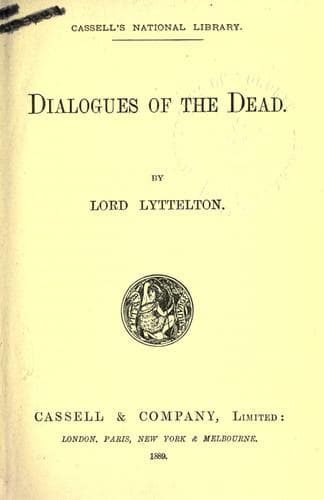
Dialogues of the DeadLyttelton, George Lyttelton, Baron
Philosophy
Dialogues of the Dead
Lyttelton, George Lyttelton, Baron
Dialogues, English -- Early works to 1800; Imaginary conversations
_Bookseller_.--Am I got into a world so absolutely the reverse of that I
left, that here authors domineer over booksellers? Dear Charon, let me
go back, and I will pay any price for my passage; but, if I must stay,
leave me not with any of those who are styled classical authors. As to
you, Plutarch, I have a particular animosity against you for having
almost occasioned my ruin. When I first set up shop, understanding but
little of business, I unadvisedly bought an edition of your "Lives," a
pack of old Greeks and Romans, which cost me a great sum of money. I
could never get off above twenty sets of them. I sold a few to the
Universities, and some to Eton and Westminster, for it is reckoned a
pretty book for boys and undergraduates; but, unless a man has the luck
to light on a pedant, he shall not sell a set of them in twenty years.
_Plutarch_.--From the merit of the subjects, I had hoped another
reception for my works. I will own, indeed, that I am not always
perfectly accurate in every circumstance, nor do I give so exact and
circumstantial a detail of the actions of my heroes as may be expected
from a biographer who has confined himself to one or two characters. A
zeal to preserve the memory of great men, and to extend the influence of
such noble examples, made me undertake more than I could accomplish in
the first degree of perfection; but surely the characters of my
illustrious men are not so imperfectly sketched that they will not stand
forth to all ages as patterns of virtue and incitements to glory. My
reflections are allowed to be deep and sagacious; and what can be more
useful to a reader than a wise man's judgment on a great man's conduct?
In my writings you will find no rash censures, no undeserved encomiums,
no mean compliance with popular opinions, no vain ostentation of critical
skill, nor any affected finesse. In my "Parallels," which used to be
admired as pieces of excellent judgment, I compare with perfect
impartiality one great man with another, and each with the rule of
justice. If, indeed, latter ages have produced greater men and better
writers, my heroes and my works ought to give place to them. As the
world has now the advantage of much better rules of morality than the
unassisted reason of poor Pagans could form, I do not wonder that those
vices, which appeared to us as mere blemishes in great characters, should
seem most horrid deformities in the purer eyes of the present age--a
delicacy I do not blame, but admire and commend. And I must censure you
for endeavouring, if you could publish better examples, to obtrude on
your countrymen such as were defective. I rejoice at the preference
which they give to perfect and unalloyed virtue; and as I shall ever
retain a high veneration for the illustrious men of every age, I should
be glad if you would give me some account of those persons who in wisdom,
justice, valour, patriotism, have eclipsed my Solon, Numa, Camillus, and
other boasts of Greece or Rome.
Public-domain text, read in full here on John Shaqi.
Reviews
Reviews
No reviews yet
Be the first to share your thoughts on this work.
Elsewhere in the archive
Join the Discussion
Join the discussion
Sign in to leave a comment or review.
Sign InorCreate an account