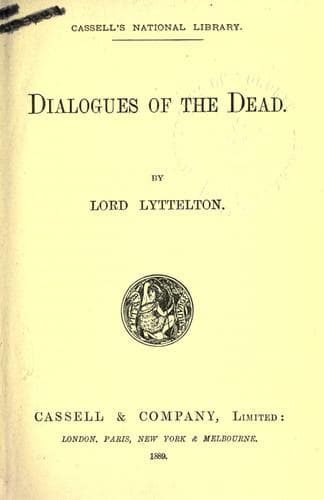
Dialogues of the DeadLyttelton, George Lyttelton, Baron
Philosophy
Dialogues of the Dead
Lyttelton, George Lyttelton, Baron
Dialogues, English -- Early works to 1800; Imaginary conversations
_Bookseller_.--Why, Master Plutarch, you are talking Greek indeed. That
work which repaired the loss I sustained by the costly edition of your
books was "The Lives of the Highwaymen;" but I should never have grown
rich if it had not been by publishing "The Lives of Men that Never
Lived." You must know that, though in all times it was possible to have
a great deal of learning and very little wisdom, yet it is only by a
modern improvement in the art of writing that a man may read all his life
and have no learning or knowledge at all, which begins to be an advantage
of the greatest importance. There is as natural a war between your men
of science and fools as between the cranes and the pigmies of old. Most
of our young men having deserted to the fools, the party of the learned
is near being beaten out of the field; and I hope in a little while they
will not dare to peep out of their forts and fastnesses at Oxford and
Cambridge. There let them stay and study old musty moralists till one
falls in love with the Greek, another with the Roman virtue; but our men
of the world should read our new books, which teach them to have no
virtue at all. No book is fit for a gentleman's reading which is not
void of facts and of doctrines, that he may not grow a pedant in his
morals or conversation. I look upon history (I mean real history) to be
one of the worst kinds of study. Whatever has happened may happen again,
and a well-bred man may unwarily mention a parallel instance he had met
with in history and be betrayed into the awkwardness of introducing into
his discourse a Greek, a Roman, or even a Gothic name; but when a
gentleman has spent his time in reading adventures that never occurred,
exploits that never were achieved, and events that not only never did,
but never can happen, it is impossible that in life or in discourse he
should ever apply them. A secret history, in which there is no secret
and no history, cannot tempt indiscretion to blab or vanity to quote; and
by this means modern conversation flows gentle and easy, unencumbered
with matter and unburdened of instruction. As the present studies throw
no weight or gravity into discourse and manners, the women are not afraid
to read our books, which not only dispose to gallantry and coquetry, but
give rules for them. Caesar's "Commentaries," and the "Account of
Xenophon's Expedition," are not more studied by military commanders than
our novels are by the fair--to a different purpose, indeed; for their
military maxims teach to conquer, ours to yield. Those inflame the vain
and idle love of glory: these inculcate a noble contempt of reputation.
The women have greater obligations to our writers than the men. By the
commerce of the world men might learn much of what they get from books;
but the poor women, who in their early youth are confined and restrained,
if it were not for the friendly assistance of books, would remain long in
Public-domain text, read in full here on John Shaqi.
Reviews
Reviews
No reviews yet
Be the first to share your thoughts on this work.
Elsewhere in the archive
Join the Discussion
Join the discussion
Sign in to leave a comment or review.
Sign InorCreate an account