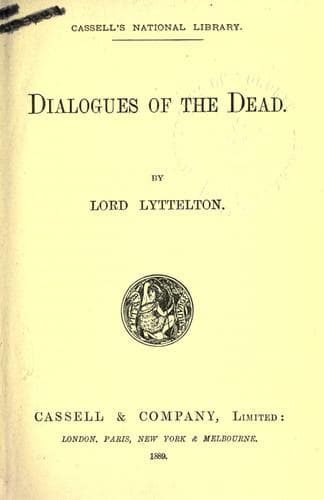
Dialogues of the DeadLyttelton, George Lyttelton, Baron
Philosophy
Dialogues of the Dead
Lyttelton, George Lyttelton, Baron
Dialogues, English -- Early works to 1800; Imaginary conversations
an insipid purity of mind, with a discouraging reserve of behaviour.
_Plutarch_.--As to your men who have quitted the study of virtue for the
study of vice, useful truth for absurd fancy, and real history for
monstrous fiction, I have neither regard nor compassion for them; but I
am concerned for the women who are betrayed into these dangerous studies;
and I wish for their sakes I had expatiated more on the character of
Lucretia and some other heroines.
_Bookseller_.--I tell you, our women do not read in order to live or to
die like Lucretia. If you would inform us that a _billet-doux_ was found
in her cabinet after her death, or give a hint as if Tarquin really saw
her in the arms of a slave, and that she killed herself not to suffer the
shame of a discovery, such anecdotes would sell very well. Or if, even
by tradition, but better still, if by papers in the Portian family, you
could show some probability that Portia died of dram drinking, you would
oblige the world very much; for you must know, that next to new-invented
characters, we are fond of new lights upon ancient characters; I mean
such lights as show a reputed honest man to have been a concealed knave,
an illustrious hero a pitiful coward, &c. Nay, we are so fond of these
kinds of information as to be pleased sometimes to see a character
cleared from a vice or crime it has been charged with, provided the
person concerned be actually dead. But in this case the evidence must be
authentic, and amount to a demonstration; in the other, a detection is
not necessary; a slight suspicion will do, if it concerns a really good
and great character.
_Plutarch_.--I am the more surprised at what you say of the taste of your
contemporaries, as I met with a Frenchman who assured me that less than a
century ago he had written a much admired "Life of Cyrus," under the name
of Artamenes, in which he ascribed to him far greater actions than those
recorded of him by Xenophon and Herodotus; and that many of the great
heroes of history had been treated in the same manner; that empires were
gained and battles decided by the valour of a single man, imagination
bestowing what nature has denied, and the system of human affairs
rendered impossible.
_Bookseller_.--I assure you those books were very useful to the authors
and their booksellers; and for whose benefit besides should a man write?
These romances were very fashionable and had a great sale: they fell in
luckily with the humour of the age.
Public-domain text, read in full here on John Shaqi.
Reviews
Reviews
No reviews yet
Be the first to share your thoughts on this work.
Elsewhere in the archive
Join the Discussion
Join the discussion
Sign in to leave a comment or review.
Sign InorCreate an account