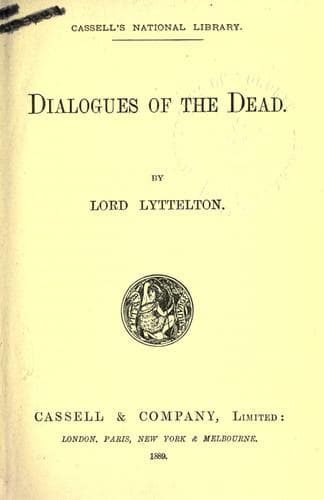
Dialogues of the DeadLyttelton, George Lyttelton, Baron
Philosophy
Dialogues of the Dead
Lyttelton, George Lyttelton, Baron
Dialogues, English -- Early works to 1800; Imaginary conversations
_Plutarch_.--It should be the first object of writers to correct the
vices and follies of the age. I will allow as much compliance with the
mode of the times as will make truth and good morals agreeable. Your
love of fictitious characters might be turned to good purpose if those
presented to the public were to be formed on the rules of religion and
morality. It must be confessed that history, being employed only about
illustrious persons, public events, and celebrated actions, does not
supply us with such instances of domestic merit as one could wish. Our
heroes are great in the field and the senate, and act well in great
scenes on the theatre of the world; but the idea of a man, who in the
silent retired path of life never deviates into vice, who considers no
spectator but the Omniscient Being, and solicits no applause but His
approbation, is the noblest model that can be exhibited to mankind, and
would be of the most general use. Examples of domestic virtue would be
more particularly useful to women than those of great heroines. The
virtues of women are blasted by the breath of public fame, as flowers
that grow on an eminence are faded by the sun and wind which expand them.
But true female praise, like the music of the spheres, arises from a
gentle, a constant, and an equal progress in the path marked out for them
by their great Creator; and, like the heavenly harmony, it is not adapted
to the gross ear of mortals, but is reserved for the delight of higher
beings, by whose wise laws they were ordained to give a silent light and
shed a mild, benignant influence on the world.
_Bookseller_.--We have had some English and French writers who aimed at
what you suggest. In the supposed character of Clarissa (said a
clergyman to me a few days before I left the world) one finds the dignity
of heroism tempered by the meekness and humility of religion, a perfect
purity of mind, and sanctity of manners. In that of Sir Charles
Grandison, a noble pattern of every private virtue, with sentiments so
exalted as to render him equal to every public duty.
_Plutarch_.--Are both these characters by the same author?
_Bookseller_.--Ay, Master Plutarch, and what will surprise you more, this
author has printed for me.
_Plutarch_.--By what you say, it is pity he should print any work but his
own. Are there no other authors who write in this manner?
Public-domain text, read in full here on John Shaqi.
Reviews
Reviews
No reviews yet
Be the first to share your thoughts on this work.
Elsewhere in the archive
Join the Discussion
Join the discussion
Sign in to leave a comment or review.
Sign InorCreate an account