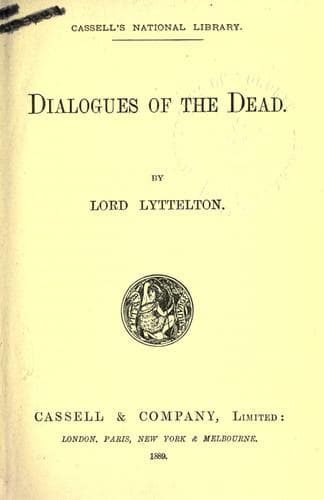
Dialogues of the DeadLyttelton, George Lyttelton, Baron
Philosophy
Dialogues of the Dead
Lyttelton, George Lyttelton, Baron
Dialogues, English -- Early works to 1800; Imaginary conversations
_Bookseller_.--Yes, we have another writer of these imaginary histories;
one who has not long since descended to these regions. His name is
Fielding, and his works, as I have heard the best judges say, have a true
spirit of comedy and an exact representation of nature, with fine moral
touches. He has not, indeed, given lessons of pure and consummate
virtue, but he has exposed vice and meanness with all the powers of
ridicule; and we have some other good wits who have exerted their talents
to the purposes you approve. Monsieur de Marivaux, and some other French
writers, have also proceeded much upon the same plan with a spirit and
elegance which give their works no mean rank among the _belles lettres_.
I will own that, when there is wit and entertainment enough in a book to
make it sell, it is not the worse for good morals.
_Charon_.--I think, Plutarch, you have made this gentleman a little more
humble, and now I will carry him the rest of his journey. But he is too
frivolous an animal to present to wise Minos. I wish Mercury were here;
he would damn him for his dulness. I have a good mind to carry him to
the Danaides, and leave him to pour water into their vessels which, like
his late readers, are destined to eternal emptiness. Or shall I chain
him to the rock, side to side by Prometheus, not for having attempted to
steal celestial fire, in order to animate human forms, but for having
endeavoured to extinguish that which Jupiter had imparted? Or shall we
constitute him _friseur_ to Tisiphone, and make him curl up her locks
with his satires and libels?
_Plutarch_.--Minos does not esteem anything frivolous that affects the
morals of mankind. He punishes authors as guilty of every fault they
have countenanced and every crime they have encouraged, and denounces
heavy vengeance for the injuries which virtue or the virtuous have
suffered in consequence of their writings.
DIALOGUE XXIX.
PUBLIUS CORNELIUS SCIPIO AFRICANUS--CAIUS JULIUS CAESAR.
_Scipio_.--Alas, Caesar! how unhappily did you end a life made
illustrious by the greatest exploits in war and most various civil
talents!
Public-domain text, read in full here on John Shaqi.
Reviews
Reviews
No reviews yet
Be the first to share your thoughts on this work.
Elsewhere in the archive
Join the Discussion
Join the discussion
Sign in to leave a comment or review.
Sign InorCreate an account