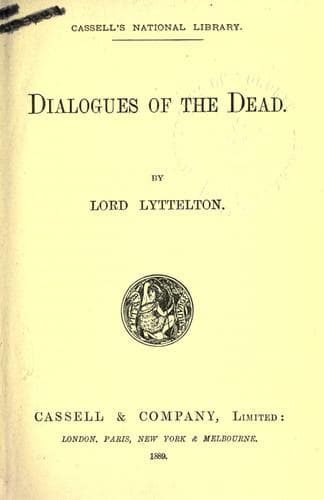
Dialogues of the DeadLyttelton, George Lyttelton, Baron
Philosophy
Dialogues of the Dead
Lyttelton, George Lyttelton, Baron
Dialogues, English -- Early works to 1800; Imaginary conversations
_Marcus Aurelius_.--I should have been happy indeed if it had been in my
power to do such good to my country. But the gods themselves cannot
force their blessings on men who by their vices are become incapable to
receive them. Liberty, like power, is only good for those who possess it
when it is under the constant direction of virtue. No laws can have
force enough to hinder it from degenerating into faction and anarchy,
where the morals of a nation are depraved; and continued habits of vice
will eradicate the very love of it out of the hearts of a people. A
Marcus Brutus in my time could not have drawn to his standard a single
legion of Romans. But, further, it is certain that the spirit of liberty
is absolutely incompatible with the spirit of conquest. To keep great
conquered nations in subjection and obedience, great standing armies are
necessary. The generals of those armies will not long remain subjects;
and whoever acquires dominion by the sword must rule by the sword. If he
does not destroy liberty, liberty will destroy him.
_Servius Tullius_.--Do you then justify Augustus for the change he made
in the Roman government?
_Marcus Aurelius_.--I do not, for Augustus had no lawful authority to
make that change. His power was usurpation and breach of trust. But the
government which he seized with a violent hand came to me by a lawful and
established rule of succession.
_Servius Tullius_.--Can any length of establishment make despotism
lawful? Is not liberty an inherent, inalienable right of mankind?
_Marcus Aurelius_.--They have an inherent right to be governed by laws,
not by arbitrary will. But forms of government may, and must, be
occasionally changed, with the consent of the people. When I reigned
over them the Romans were governed by laws.
_Servius Tullius_.--Yes, because your moderation and the precepts of that
philosophy in which your youth had been tutored inclined you to make the
laws the rules of your government and the bounds of your power. But if
you had desired to govern otherwise, had they power to restrain you?
_Marcus Aurelius_.--They had not. The imperial authority in my time had
no limitations.
_Servius Tullius_.--Rome therefore was in reality as much enslaved under
you as under your son; and you left him the power of tyrannising over it
by hereditary right?
_Marcus Aurelius_.--I did; and the conclusion of that tyranny was his
murder.
Public-domain text, read in full here on John Shaqi.
Reviews
Reviews
No reviews yet
Be the first to share your thoughts on this work.
Elsewhere in the archive
Join the Discussion
Join the discussion
Sign in to leave a comment or review.
Sign InorCreate an account