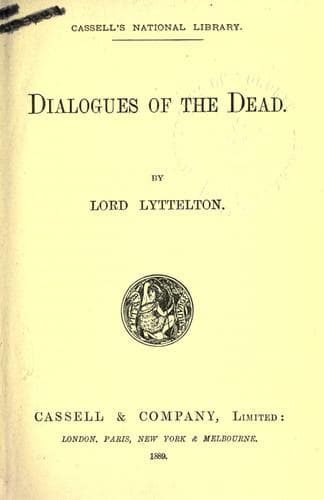
Dialogues of the DeadLyttelton, George Lyttelton, Baron
Philosophy
Dialogues of the Dead
Lyttelton, George Lyttelton, Baron
Dialogues, English -- Early works to 1800; Imaginary conversations
_Servius Tullius_.--Yes, Marcus, though I own you to have been the first
of mankind in virtue and goodness--though, while you governed, Philosophy
sat on the throne and diffused the benign influences of her
administration over the whole Roman Empire--yet as a king I might,
perhaps, pretend to a merit even superior to yours.
_Marcus Aurelius_.--That philosophy you ascribe to me has taught me to
feel my own defects, and to venerate the virtues of other men. Tell me,
therefore, in what consisted the superiority of your merit as a king.
_Servius Tullius_.--It consisted in this--that I gave my people freedom.
I diminished, I limited the kingly power, when it was placed in my hands.
I need not tell you that the plan of government instituted by me was
adopted by the Romans when they had driven out Tarquin, the destroyer of
their liberty; and gave its form to that republic, composed of a due
mixture of the regal, aristocratical, and democratical powers, the
strength and wisdom of which subdued the world. Thus all the glory of
that great people, who for many ages excelled the rest of mankind in the
arts of war and of policy, belongs originally to me.
_Marcus Aurelius_.--There is much truth in what you say. But would not
the Romans have done better if, after the expulsion of Tarquin, they had
vested the regal power in a limited monarch, instead of placing it in two
annual elective magistrates with the title of consuls? This was a great
deviation from your plan of government, and, I think, an unwise one. For
a divided royalty is a solecism--an absurdity in politics. Nor was the
regal power committed to the administration of consuls continued in their
hands long enough to enable them to finish any difficult war or other act
of great moment. From hence arose a necessity of prolonging their
commands beyond the legal term; of shortening the interval prescribed by
the laws between the elections to those offices; and of granting
extraordinary commissions and powers, by all which the Republic was in
the end destroyed.
_Servius Tullius_.--The revolution which ensued upon the death of
Lucretia was made with so much anger that it is no wonder the Romans
abolished in their fury the name of king, and desired to weaken a power
the exercise of which had been so grievous, though the doing this was
attended with all the inconveniences you have justly observed. But, if
anger acted too violently in reforming abuses, philosophy might have
wisely corrected that error. Marcus Aurelius might have new-modelled the
constitution of Rome. He might have made it a limited monarchy, leaving
to the emperors all the power that was necessary to govern a
wide-extended empire, and to the Senate and people all the liberty that
could be consistent with order and obedience to government--a liberty
purged of faction and guarded against anarchy.
Public-domain text, read in full here on John Shaqi.
Reviews
Reviews
No reviews yet
Be the first to share your thoughts on this work.
Elsewhere in the archive
Join the Discussion
Join the discussion
Sign in to leave a comment or review.
Sign InorCreate an account