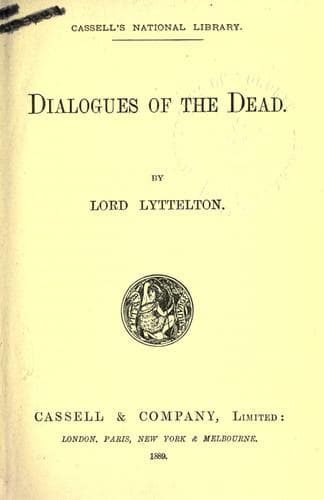
Dialogues of the DeadLyttelton, George Lyttelton, Baron
Philosophy
Dialogues of the Dead
Lyttelton, George Lyttelton, Baron
Dialogues, English -- Early works to 1800; Imaginary conversations
_Penn_.--Though what thou sayest should be true, it does not come well
from thy mouth. A Papist talk of reason! Go to the Inquisition and tell
them of reason and the great laws of Nature. They will broil thee, as
thy soldiers broiled the unhappy Guatimozin. Why dost thou turn pale? Is
it the name of the Inquisition, or the name of Guatimozin, that troubles
and affrights thee? O wretched man! who madest thyself a voluntary
instrument to carry into a new-discovered world that hellish tribunal?
Tremble and shake when thou thinkest that every murder the Inquisitors
have committed, every torture they have inflicted on the innocent
Indians, is originally owing to thee. Thou must answer to God for all
their inhumanity, for all their injustice. What wouldst thou give to
part with the renown of thy conquests, and to have a conscience as pure
and undisturbed as mine?
_Cortez_.--I feel the force of thy words; they pierce me like daggers. I
can never, never be happy, while I retain any memory of the ills I have
caused. Yet I thought I did right. I thought I laboured to advance the
glory of God and propagate, in the remotest parts of the earth, His holy
religion. He will be merciful to well designing and pious error. Thou
also wilt have need of that gracious indulgence, though not, I own, so
much as I.
_Penn_.--Ask thy heart whether ambition was not thy real motive and zeal
the pretence?
_Cortez_.--Ask thine whether thy zeal had no worldly views and whether
thou didst believe all the nonsense of the sect, at the head of which
thou wast pleased to become a legislator.--Adieu. Self-examination
requires retirement.
DIALOGUE IX.
MARCUS PORTIUS CATO--MESSALLA CORVINUS.
_Cato_.--Oh, Messalla! is it then possible that what some of our
countrymen tell me should be true? Is it possible that you could live
the courtier of Octavius; that you could accept of employments and
honours from him, from the tyrant of your country; you, the brave, the
noble-minded, the virtuous Messalla; you, whom I remember, my son-in-law
Brutus has frequently extolled as the most promising youth in Rome,
tutored by philosophy, trained up in arms, scorning all those soft,
effeminate pleasures that reconcile men to an easy and indolent
servitude, fit for all the roughest tasks of honour and virtue, fit to
live or to die a free man?
_Messalla_.--Marcus Cato, I revere both your life and your death; but the
last, permit me to tell you, did no good to your country, and the former
would have done more if you could have mitigated a little the sternness
of your virtue, I will not say of your pride. For my own part, I adhered
with constant integrity and unwearied zeal to the Republic, while the
Republic existed. I fought for her at Philippi under the only commander,
who, if he had conquered, would have conquered for her, not for himself.
When he was dead I saw that nothing remained to my country but the choice
of a master. I chose the best.
Public-domain text, read in full here on John Shaqi.
Reviews
Reviews
No reviews yet
Be the first to share your thoughts on this work.
Join the Discussion
Join the discussion
Sign in to leave a comment or review.
Sign InorCreate an account