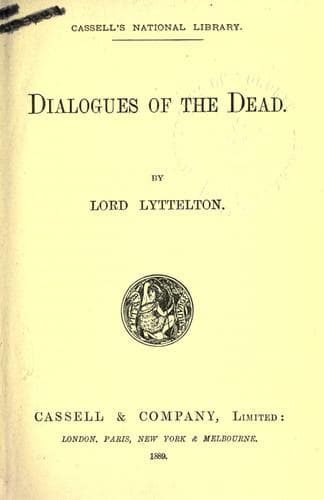
Dialogues of the DeadLyttelton, George Lyttelton, Baron
Philosophy
Dialogues of the Dead
Lyttelton, George Lyttelton, Baron
Dialogues, English -- Early works to 1800; Imaginary conversations
Believe me, Cato, it is better to do some good than to project a great
deal. A little practical virtue is of more use to society than the most
sublime theory, or the best principles of government ill applied.
_Cato_.--Yet I must think it was beneath the character of Messalla to
join in supporting a government which, though coloured and mitigated, was
still a tyranny. Had you not better have gone into a voluntary exile,
where you would not have seen the face of the tyrant, and where you might
have quietly practised those private virtues which are all that the gods
require from good men in certain situations?
_Messalla_.--No; I did much more good by continuing at Rome. Had
Augustus required of me anything base, anything servile, I would have
gone into exile, I would have died, rather than do it. But he respected
my virtue, he respected my dignity; he treated me as well as Agrippa, or
as Maecenas, with this distinction alone, that he never employed my sword
but against foreign nations, or the old enemies of the republic.
_Cato_.--It must, I own, have been a pleasure to be employed against
Antony, that monster of vice, who plotted the ruin of liberty, and the
raising of himself to sovereign power, amidst the riot of bacchanals, and
in the embraces of harlots, who, when he had attained to that power,
delivered it up to a lascivious queen, and would have made an Egyptian
strumpet the mistress of Rome, if the Battle of Actium had not saved us
from that last of misfortunes.
_Messalla_.--In that battle I had a considerable share. So I had in
encouraging the liberal arts and sciences, which Augustus protected.
Under his judicious patronage the muses made Rome their capital seat. It
would have pleased you to have known Virgil, Horace, Tibullus, Ovid,
Livy, and many more, whose names will be illustrious to all generations.
_Cato_.--I understand you, Messalla. Your Augustus and you, after the
ruin of our liberty, made Rome a Greek city, an academy of fine wits,
another Athens under the government of Demetrius Phalareus. I had much
rather have seen her under Fabricius and Curius, and her other honest old
consuls, who could not read.
Public-domain text, read in full here on John Shaqi.
Reviews
Reviews
No reviews yet
Be the first to share your thoughts on this work.
Join the Discussion
Join the discussion
Sign in to leave a comment or review.
Sign InorCreate an account