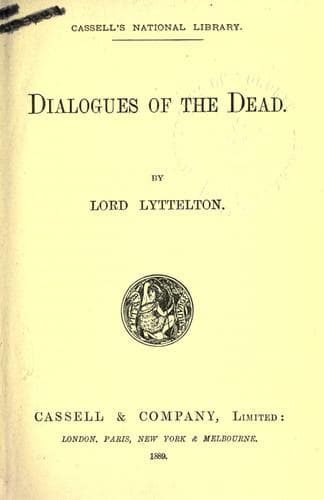
Dialogues of the DeadLyttelton, George Lyttelton, Baron
Philosophy
Dialogues of the Dead
Lyttelton, George Lyttelton, Baron
Dialogues, English -- Early works to 1800; Imaginary conversations
_Mr. Hampden_.--I own I did, and I don't wonder at the severity of your
thoughts about me. The heat of the times deprived us both of our natural
candour. Yet I will confess to you here, that, before I died, I began to
see in our party enough to justify your apprehensions that the civil war,
which we had entered into from generous motives, from a laudable desire
to preserve our free constitution, would end very unhappily, and perhaps,
in the issue, destroy that constitution, even by the arms of those who
pretended to be most zealous for it.
_Lord Falkland_.--And I will as frankly own to you that I saw, in the
court and camp of the king, so much to alarm me for the liberty of my
country, if our arms were successful, that I dreaded a victory little
less than I did a defeat, and had nothing in my mouth but the word peace,
which I constantly repeated with passionate fondness, in every council at
which I was called to assist.
_Mr. Hampden_.--I wished for peace too, as ardently as your lordship, but
I saw no hopes of it. The insincerity of the king and the influence of
the queen made it impossible to trust to his promises and declarations.
Nay, what reliance could we reasonably have upon laws designed to limit
and restrain the power of the Crown, after he had violated the Bill of
Rights, obtained with such difficulty, and containing so clear an
assertion of the privileges which had been in dispute? If his conscience
would allow him to break an Act of Parliament, made to determine the
bounds of the royal prerogative, because he thought that the royal
prerogative could have no bounds, what legal ties could bind a conscience
so prejudiced? or what effectual security could his people obtain against
the obstinate malignity of such an opinion, but entirely taking from him
the power of the sword, and enabling themselves to defend the laws he had
passed?
_Lord Falkland_.--There is evidently too much truth in what you have
said. But by taking from the king the power of the sword, you in reality
took all power. It was converting the government into a democracy; and
if he had submitted to it, he would only have preserved the name of a
king. The sceptre would have been held by those who had the sword; or we
must have lived in a state of perpetual anarchy, without any force or
balance in the government; a state which could not have lasted long, but
would have ended in a republic or in absolute dominion.
_Mr. Hampden_.--Your reasoning seems unanswerable. But what could we do?
Let Dr. Laud and those other court divines, who directed the king's
conscience, and fixed in it such principles as made him unfit to govern a
limited monarchy--though with many good qualities, and some great
ones--let them, I say, answer for all the mischiefs they brought upon him
and the nation.
Public-domain text, read in full here on John Shaqi.
Reviews
Reviews
No reviews yet
Be the first to share your thoughts on this work.
Join the Discussion
Join the discussion
Sign in to leave a comment or review.
Sign InorCreate an account