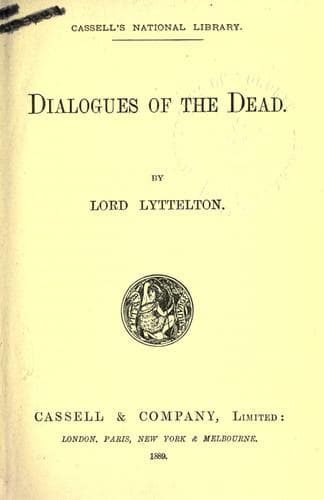
Dialogues of the DeadLyttelton, George Lyttelton, Baron
Philosophy
Dialogues of the Dead
Lyttelton, George Lyttelton, Baron
Dialogues, English -- Early works to 1800; Imaginary conversations
_Countess of Clanricarde_.--Your Highness must not judge of all hearts by
your own. The ruling passion of that was apparently ambition. My
inclinations were not so noble as yours, but better suited, perhaps, to
the nature of woman. I loved Sir Philip Sidney, I loved the Earl of
Essex, rather as amiable men than as heroes and statesmen. They were so
taken up with their wars and state-affairs, that my tenderness for them
was too often neglected. The Earl of Clanricarde was constantly and
wholly mine. He was brave, but had not that spirit of chivalry with
which Sir Philip Sidney was absolutely possessed. He had, in a high
degree, the esteem of Elizabeth, but did not aspire to her love; nor did
he wish to be the rival of Carr or of Villiers in the affection of James.
Such, madam, was the man on whom my last choice bestowed my hand, and
whose kindness compensated for all my misfortunes. Providence has
assigned to different tempers different comforts. To you it gave the
education of a prince, the government of a state, the pride of being
called the wife of a hero; to me a good-living husband, quiet, opulence,
nobility, and a fair reputation, though not in a degree so exalted as
yours. If our whole sex were to choose between your consolations and
mine, your Highness, I think, would find very few of your taste. But I
respect the sublimity of your ideas. Now that we have no bodies they
appear less unnatural than I should have thought them in the other world.
_Princess of Orange_.--Adieu, madam. Our souls are of a different order,
and were not made to sympathise or converse with each other.
DIALOGUE XVII.
MARCUS BRUTUS--POMPONIUS ATTICUS.
_Brutus_.--Well, Atticus, I find that, notwithstanding your friendship
for Cicero and for me, you survived us both many years, with the same
cheerful spirit you had always possessed, and, by prudently wedding your
daughter to Agrippa, secured the favour of Octavius Caesar, and even
contracted a close alliance with him by your granddaughter's marriage
with Tiberius Nero.
_Atticus_.--You know, Brutus, my philosophy was the Epicurean. I loved
my friends, and I served them in their wants and distresses with great
generosity; but I did not think myself obliged to die when they died, or
not to make others as occasions should offer.
_Brutus_.--You did, I acknowledge, serve your friends, as far as you
could, without bringing yourself, on their account, into any great danger
or disturbance of mind: but that you loved them I much doubt. If you
loved Cicero, how could you love Antony? If you loved me, how could you
love Octavius? If you loved Octavius, how could you avoid taking part
against Antony in their last civil war? Affection cannot be so strangely
divided, and with so much equality, among men of such opposite
characters, and who were such irreconcilable enemies to each other.
Public-domain text, read in full here on John Shaqi.
Reviews
Reviews
No reviews yet
Be the first to share your thoughts on this work.
Elsewhere in the archive
Join the Discussion
Join the discussion
Sign in to leave a comment or review.
Sign InorCreate an account