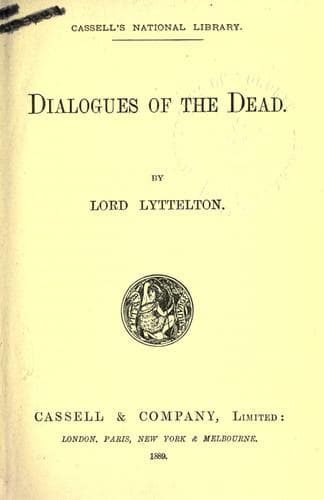
Dialogues of the DeadLyttelton, George Lyttelton, Baron
Philosophy
Dialogues of the Dead
Lyttelton, George Lyttelton, Baron
Dialogues, English -- Early works to 1800; Imaginary conversations
_Atticus_.--From my earliest youth I possessed the singular talent of
ingratiating myself with the heads of different parties, and yet not
engaging with any of them so far as to disturb my own quiet. My family
was connected with the Marian party; and, though I retired to Athens that
I might not be unwillingly involved in the troubles which that turbulent
faction had begun to excite, yet when young Marius was declared an enemy
by the Senate, I sent him a sum of money to support him in his exile. Nor
did this hinder me from making my court so well to Sylla, upon his coming
to Athens, that I obtained from him the highest marks of his favour.
Nevertheless, when he pressed me to go with him to Rome, I declined it,
being as unwilling to fight for him against the Marian party, as for them
against him. He admired my conduct; and at his departure from Athens,
ordered all the presents made to him during his abode in that city to be
carried to me. I remind you of this only to show that moderation in all
contentions of this kind had been always my principle; and that in the
instances you mentioned I did not act from any levity or inconstancy in
my nature, but from a regular consistent plan of conduct, which my reason
convinced me was the wisest I could follow.
_Brutus_.--I remember indeed that you observed the same neutrality
between Pompey and Julius Caesar.
_Atticus_.--I did so--and that I might be able to do it with dignity, and
without the reproach of ingratitude, I never would accept any office or
honour from either of those great men; nor from Cicero, though my sister
had married his brother; nor from you, Marcus Brutus, whose friendship I
thought the greatest honour of my life.
_Brutus_.--Are there no obligations to a good heart, Pomponius, but
honours and offices? Or could you, by refusing to encumber yourself with
these, dissolve all other ties? But, setting aside any considerations of
private affection or esteem, how was you able to reconcile your conduct
with that which is the ruling principle in the heart of every virtuous
man, and more especially a virtuous Roman, the love of the public?
_Atticus_.--The times I lived in were so bad, and the conflict of parties
had so little to do in reality with the love of the public, that I
thought my virtue much safer and purer by avoiding than mixing in the
fray.
Public-domain text, read in full here on John Shaqi.
Reviews
Reviews
No reviews yet
Be the first to share your thoughts on this work.
Elsewhere in the archive
Join the Discussion
Join the discussion
Sign in to leave a comment or review.
Sign InorCreate an account