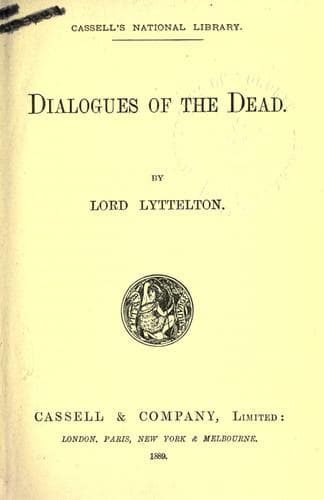
Dialogues of the DeadLyttelton, George Lyttelton, Baron
Philosophy
Dialogues of the Dead
Lyttelton, George Lyttelton, Baron
Dialogues, English -- Early works to 1800; Imaginary conversations
_Fenelon_.--I know you to be Plato, the most amiable of all the disciples
of Socrates, and the philosopher of all antiquity whom I most desired to
resemble.
_Plato_.--Homer and Orpheus are impatient to see you in that region of
these happy fields which their shades inhabit. They both acknowledge you
to be a great poet, though you have written no verses. And they are now
busy in composing for you unfading wreaths of all the finest and sweetest
Elysian flowers. But I will lead you from them to the sacred grove of
philosophy, on the highest hill of Elysium, where the air is most pure
and most serene. I will conduct you to the fountain of wisdom, in which
you will see, as in your own writings, the fair image of virtue
perpetually reflected. It will raise in you more love than was felt by
Narcissus, when he contemplated the beauty of his own face in the
unruffled spring. But you shall not pine, as he did, for a shadow. The
goddess herself will affectionately meet your embraces and mingle with
your soul.
_Fenelon_.--I find you retain the allegorical and poetical style, of
which you were so fond in many of your writings. Mine also run sometimes
into poetry, particularly in my "Telemachus," which I meant to make a
kind of epic composition. But I dare not rank myself among the great
poets, nor pretend to any equality in oratory with you, the most eloquent
of philosophers, on whose lips the Attic bees distilled all their honey.
_Plato_.--The French language is not so harmonious as the Greek, yet you
have given a sweetness to it which equally charms the ear and heart. When
one reads your compositions, one thinks that one hears Apollo's lyre,
strung by the hands of the Graces, and tuned by the Muses. The idea of a
perfect king, which you have exhibited in your "Telemachus," far excels,
in my own judgment, my imaginary "Republic." Your "Dialogues" breathe
the pure spirit of virtue, of unaffected good sense, of just criticism,
of fine taste. They are in general as superior to your countryman
Fontenelle's as reason is to false wit, or truth to affectation. The
greatest fault of them, I think, is, that some are too short.
_Fenelon_.--It has been objected to them--and I am sensible of it
myself--that most of them are too full of commonplace morals. But I
wrote them for the instruction of a young prince, and one cannot too
forcibly imprint on the minds of those who are born to empire the most
simple truths; because, as they grow up, the flattery of a court will try
to disguise and conceal from them those truths, and to eradicate from
their hearts the love of their duty, if it has not taken there a very
deep root.
Public-domain text, read in full here on John Shaqi.
Reviews
Reviews
No reviews yet
Be the first to share your thoughts on this work.
Join the Discussion
Join the discussion
Sign in to leave a comment or review.
Sign InorCreate an account