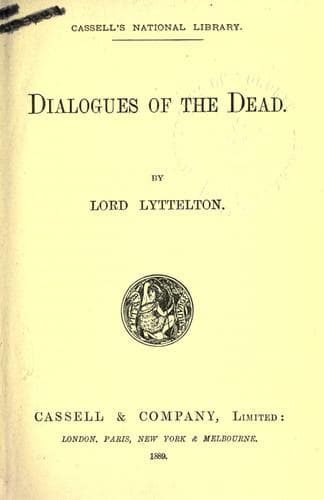
Dialogues of the DeadLyttelton, George Lyttelton, Baron
Philosophy
Dialogues of the Dead
Lyttelton, George Lyttelton, Baron
Dialogues, English -- Early works to 1800; Imaginary conversations
_Alexander_.--It may perhaps be admitted, as some excuse for my
drunkenness, that the Persians esteemed it an excellence in their kings
to be able to drink a great quantity of wine, and the Macedonians were
far from thinking it a dishonour. But you were as frantic and as cruel
when sober as I was when drunk. You were sober when you resolved to
continue in Turkey against the will of your host, the Grand Signor. You
were sober when you commanded the unfortunate Patkull, whose only crime
was his having maintained the liberties of his country, and who bore the
sacred character of an ambassador, to be broken alive on the wheel,
against the laws of nations, and those of humanity, more inviolable still
to a generous mind. You were likewise sober when you wrote to the Senate
of Sweden, who, upon a report of your death, endeavoured to take some
care of your kingdom, that you would send them one of your boots, and
from that they should receive their orders if they pretended to meddle in
government--an insult much worse than any the Macedonians complained of
from me when I was most heated with wine and with adulation. As for my
chastity, it was not so perfect as yours, though on some occasions I
obtained great praise for my continence; but, perhaps, if you had been
not quite so insensible to the charms of the fair sex, it would have
mitigated and softened the fierceness, the pride, and the obstinacy of
your nature.
_Charles_.--It would have softened me into a woman, or, what I think
still more contemptible, the slave of a woman. But you seem to insinuate
that you never were cruel or frantic unless when you were drunk. This I
absolutely deny. You were not drunk when you crucified Hephaestion's
physician for not curing a man who killed himself by his intemperance in
his sickness, nor when you sacrificed to the manes of that favourite
officer the whole nation of the Cusseans--men, women, and children--who
were entirely innocent of his death--because you had read in Homer that
Achilles had immolated some Trojan captives on the tomb of Patroclus. I
could mention other proofs that your passions inflamed you as much as
wine, but these are sufficient.
Public-domain text, read in full here on John Shaqi.
Reviews
Reviews
No reviews yet
Be the first to share your thoughts on this work.
Elsewhere in the archive
Join the Discussion
Join the discussion
Sign in to leave a comment or review.
Sign InorCreate an account