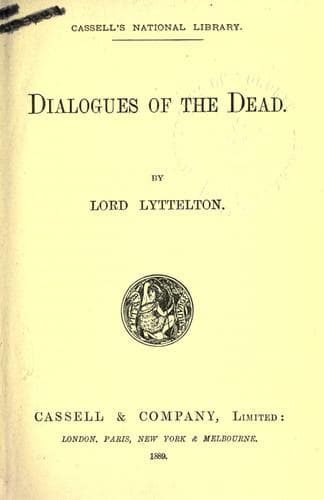
Dialogues of the DeadLyttelton, George Lyttelton, Baron
Philosophy
Dialogues of the Dead
Lyttelton, George Lyttelton, Baron
Dialogues, English -- Early works to 1800; Imaginary conversations
_Cosmo_.--Those orators could not gain the favour of the people by any
other methods. Your arts were more noble--they were the arts of a
statesman and of a prince. Your magnificent buildings (which in beauty
of architecture surpassed any the world had ever seen), the statues of
Phidias, the paintings of Zeuxis, the protection you gave to knowledge,
genius, and abilities of every kind, added as much to the glory of Athens
as to your popularity. And in this I may boast of an equal merit to
Florence. For I embellished that city and the whole country about it
with excellent buildings; I protected all arts; and, though I was not
myself so eloquent or so learned as you, I no less encouraged those who
were eminent in my time for their eloquence or their learning. Marcilius
Ficinus, the second father of the Platonic philosophy, lived in my house,
and conversed with me as intimately as Anaxagoras with you. Nor did I
ever forget and suffer him so to want the necessaries of life as you did
Anaxagoras, who had like to have perished by that unfriendly neglect; but
to secure him at all times from any distress in his circumstances, and
enable him to pursue his sublime speculations unmolested by low cares, I
gave him an estate adjacent to one of my favourite villas. I also drew
to Florence Argiropolo, the most learned Greek of those times, that,
under my patronage, he might teach the Florentine youth the language and
sciences of his country. But with regard to our buildings, there is this
remarkable difference--yours were all raised at the expense of the
public, mine at my own.
_Pericles_.--My estate would bear no profuseness, nor allow me to exert
the generosity of my nature. Your wealth exceeded that of any
particular, or indeed of any prince who lived in your days. The vast
commerce which, after the example of your ancestors, you continued to
carry on in all parts of the world, even while you presided at the helm
of the State, enabled you to do those splendid acts which rendered your
name so illustrious. But I was constrained to make the public treasure
the fund of my bounties; and I thought I could not possibly dispose of it
better in time of peace than in finding employment for that part of the
people which must else have been idle and useless to the community,
introducing into Greece all the elegant arts, and adorning my country
with works that are an honour to human nature; for, while I attended the
most to these civil and peaceful occupations, I did not neglect to
provide, with timely care, against war, nor suffer the nation to sink
into luxury and effeminate softness. I kept our fleets in continual
exercise, maintained a great number of seamen in constant pay, and
disciplined well our land forces. Nor did I ever cease to recommend to
all the Athenians, both by precepts and example, frugality, temperance,
magnanimity, fortitude, and whatever could most effectually contribute to
strengthen their bodies and minds.
Public-domain text, read in full here on John Shaqi.
Reviews
Reviews
No reviews yet
Be the first to share your thoughts on this work.
Elsewhere in the archive
Join the Discussion
Join the discussion
Sign in to leave a comment or review.
Sign InorCreate an account