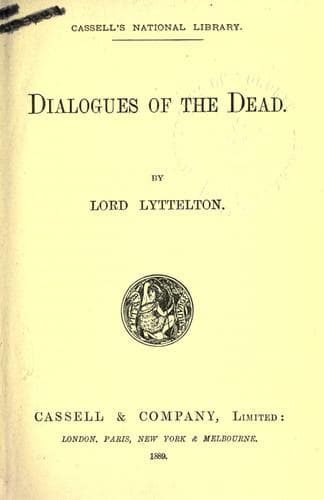
Dialogues of the DeadLyttelton, George Lyttelton, Baron
Philosophy
Dialogues of the Dead
Lyttelton, George Lyttelton, Baron
Dialogues, English -- Early works to 1800; Imaginary conversations
_Cosmo_.--Yet I have heard you condemned for rendering the people less
sober and modest, by giving them a share of the conquered lands, and
paying them wages for their necessary attendance in the public assemblies
and other civil functions; but more especially for the vast and
superfluous expense you entailed on the State in the theatrical
spectacles with which you entertained them at the cost of the public.
_Pericles_.--Perhaps I may have been too lavish in some of those
bounties. Yet in a popular State it is necessary that the people should
be amused, and should so far partake of the opulence of the public as not
to suffer any want, which would render their minds too low and sordid for
their political duties. In my time the revenues of Athens were
sufficient to bear this charge; but afterwards, when we had lost the
greatest part of our empire, it became, I must confess, too heavy a
burden, and the continuance of it proved one cause of our ruin.
_Cosmo_.--It is a most dangerous thing to load the State with largesses
of that nature, or indeed with any unnecessary but popular charges,
because to reduce them is almost impossible, though the circumstances of
the public should necessarily demand a reduction. But did not you
likewise, in order to advance your own greatness, throw into the hands of
the people of Athens more power than the institutions of Solon had
entrusted them with, and more than was consistent with the good of the
State?
_Pericles_.--We are now in the regions where Truth presides, and I dare
not offend her by playing the orator in defence of my conduct. I must
therefore acknowledge that, by weakening the power of the court of
Areopagus, I tore up that anchor which Solon had wisely fixed to keep his
Republic firm against the storms and fluctuations of popular factions.
This alteration, which fundamentally injured the whole State, I made with
a view to serve my own ambition, the only passion in my nature which I
could not contain within the limits of virtue. For I knew that my
eloquence would subject the people to me, and make them the willing
instruments of all my desires; whereas the Areopagus had in it an
authority and a dignity which I could not control. Thus by diminishing
the counterpoise our Constitution had settled to moderate the excess of
popular power, I augmented my own. But since my death I have been often
reproached by the Shades of some of the most virtuous and wisest
Athenians, who have fallen victims to the caprice or fury of the people,
with having been the first cause of the injustice they suffered, and of
all the mischiefs perpetually brought on my country by rash undertakings,
bad conduct, and fluctuating councils. They say, I delivered up the
State to the government of indiscreet or venal orators, and to the
passions of a misguided, infatuated multitude, who thought their freedom
consisted in encouraging calumnies against the best servants of the
Public-domain text, read in full here on John Shaqi.
Reviews
Reviews
No reviews yet
Be the first to share your thoughts on this work.
Elsewhere in the archive
Join the Discussion
Join the discussion
Sign in to leave a comment or review.
Sign InorCreate an account