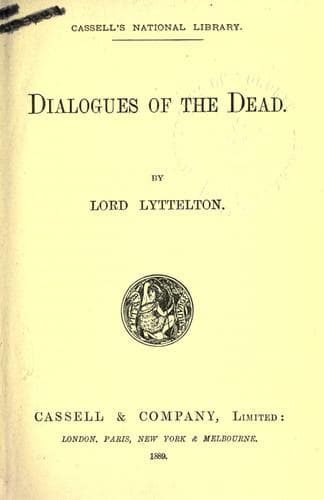
Dialogues of the DeadLyttelton, George Lyttelton, Baron
Philosophy
Dialogues of the Dead
Lyttelton, George Lyttelton, Baron
Dialogues, English -- Early works to 1800; Imaginary conversations
_Bayle_.--I own it did; but your comparison is not just. I did not see
well before I used my philosophic eye-water. I only supposed I saw well;
but I was in an error, with all the rest of mankind. The blindness was
real; the perceptions were imaginary. I cured myself first of those
false imaginations, and then I laudably endeavoured to cure other men.
_Locke_.--A great cure, indeed! and don't you think that, in return for
the service you did them, they ought to erect you a statue?
_Bayle_.--Yes; it is good for human nature to know its own weakness. When
we arrogantly presume on a strength we have not, we are always in great
danger of hurting ourselves--or, at least, of deserving ridicule and
contempt by vain and idle efforts.
_Locke_.--I agree with you that human nature should know its own
weakness; but it should also feel its strength, and try to improve it.
This was my employment as a philosopher. I endeavoured to discover the
real powers of the mind; to see what it could do, and what it could not;
to restrain it from efforts beyond its ability, but to teach it how to
advance as far as the faculties given to it by Nature, with the utmost
exertion and most proper culture of them, would allow it to go. In the
vast ocean of philosophy I had the line and the plummet always in my
hands. Many of its depths I found myself unable to fathom; but by
caution in sounding, and the careful observations I made in the course of
my voyage, I found out some truths of so much use to mankind that they
acknowledge me to have been their benefactor.
_Bayle_.--Their ignorance makes them think so. Some other philosopher
will come hereafter, and show those truths to be falsehoods. He will
pretend to discover other truths of equal importance. A later sage will
arise, perhaps among men now barbarous and unlearned, whose sagacious
discoveries will discredit the opinions of his admired predecessor. In
philosophy, as in Nature, all changes its form, and one thing exists by
the destruction of another.
Public-domain text, read in full here on John Shaqi.
Reviews
Reviews
No reviews yet
Be the first to share your thoughts on this work.
Elsewhere in the archive
Join the Discussion
Join the discussion
Sign in to leave a comment or review.
Sign InorCreate an account