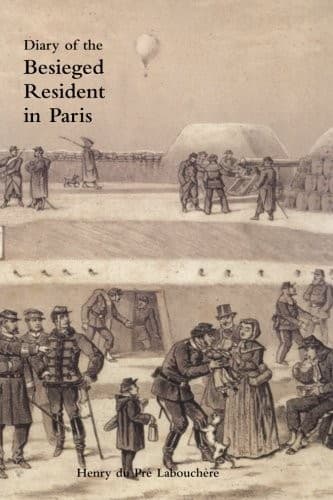
Diary of the Besieged Resident in ParisLabouchere, Henry Du Pré
History
Diary of the Besieged Resident in Paris
Labouchere, Henry Du Pré
Franco-Prussian War, 1870-1871; Paris (France) -- History -- Siege, 1870-1871 -- Personal narratives
All yesterday afternoon and evening the Fort of Issy, and the battery of
the Bois de Boulogne, fired heavily on Brinborion and Meudon, with what
result no one knows. Yesterday morning the _Combat_ announced that
Marshal Bazaine was treating for the surrender of Metz in the name of
Napoleon. The Government was interviewed, and denied the fact. In the
evening the _Combat_ was burnt on the Boulevards. The chief of General
Ducrot's staff has published a letter protesting against the assertions
of certain journals that the fight at Malmaison produced no results. On
the contrary, he says it gained us sixty square kilometres of ground in
the plain of Genevilliers.
CHAPTER IX.
_October 28th._
I see at a meeting of the mayors, the population of Paris is put down at
2,036,000. This does not include the regular army, or the Marines and
Mobiles outside and within the lines. The consumption of meat,
consequently, at the rate of 100 grammes per diem, must amount to
between 400,000 and 500,000lbs. per diem. Although mutton according to
the tariff is cheaper than beef, I rarely see any at the restaurants.
This tells its own tale, and I imagine that in three weeks from now at
the very latest fresh meat will have come to an end.
I am reluctantly coming to the conclusion that there is no more fight in
the working men than in the bourgeois. The National Guard in Montmartre
and Batignolles have held an indignation meeting to protest against
their being employed in the forts. A law was passed on August 10 calling
under arms all unmarried men between 25 and 40. In Paris it has never
been acted on; it would, however, be far better to regularly enrol this
portion of the National Guard as soldiers than to ask for volunteers. As
long as these "sedentary" warriors can avoid regular service, or
subjecting themselves to the discipline and the hardships of real
soldiers, they will do so. Before the Pantheon, the mayor of an
arrondissement sits on a platform, writing down the names of volunteers.
Whenever one makes his appearance, a roll of drums announces to his
fellow-citizens that he has undertaken to risk his valuable life outside
the ramparts. It really does appear too monstrous that the able-bodied
men of this city should wear uniforms, learn the goose-step, and refuse
to take any part in the defence within shot of the enemy. That they
should object to be employed in a campaign away from their homes, is
hardly in accordance with their appeal to the provinces to rise _en
masse_ to defend France, but that they should decline to do anything but
go over every twelve days to the ramparts, is hardly fighting even for
their own homes. Surely as long as the siege lasts they ought to
consider that the Government has a right to use them anywhere within the
lines of investment They make now what they call military promenades,
that is to say, they go out at one gate, keep well within the line of
the forts, and come in at another gate. Some of the battalions are ready
Public-domain text, read in full here on John Shaqi.
Reviews
Reviews
No reviews yet
Be the first to share your thoughts on this work.
Elsewhere in the archive
Join the Discussion
Join the discussion
Sign in to leave a comment or review.
Sign InorCreate an account