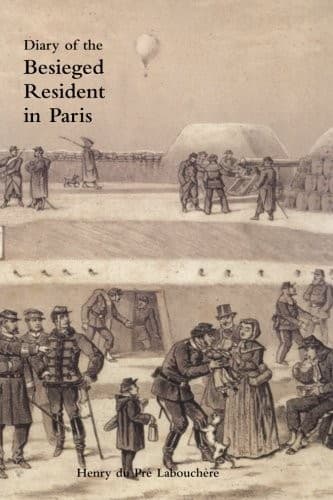
Diary of the Besieged Resident in ParisLabouchere, Henry Du Pré
History
Diary of the Besieged Resident in Paris
Labouchere, Henry Du Pré
Franco-Prussian War, 1870-1871; Paris (France) -- History -- Siege, 1870-1871 -- Personal narratives
to face the enemy, although they will not submit to any discipline. The
majority, however, do not intend to fight outside the ramparts. I was
reading yesterday the account of a court-martial on one of these heroes,
who had fallen out with his commanding officer, and threatened to pass
his sword through his body. The culprit, counsel urged, was a man of an
amiable, though excitable disposition; the father of two sons, had once
saved a child from drowning, and had presented several curiosities to a
museum. Taking these facts into consideration, the Court condemned him
to six days' imprisonment, his accuser apologised to him, and shook
hands with him. What is to be expected of troops when military offences
of the grossest kind are treated in this fashion? I know myself officers
of the Garde Nationale, who, when they are on duty at the ramparts,
quietly leave their men there, and come home to dinner. No one appears
to consider this anything extraordinary. Well may General Trochu look up
to the sky when it is overcast, and wish that he were in Brittany
shooting woodcocks. He has undertaken a task beyond his own strength,
and beyond the strength of the greatest general that ever lived. How can
the Parisians expect to force the Prussians to raise the siege? They
decline to be soldiers, and yet imagine that in some way or other, not
only is their city not to be desecrated by the foot of the invader, but
that the armies of Germany are to be driven out of France.
_October 30th._
We really have had a success. Between the north-eastern and the
north-western forts there is a plain, cut up by small streams. The high
road from Paris to Senlis runs through the middle of it, and on this
road, at a distance of about six kilometres from Paris, is the village
of Bourget, which was occupied by the Prussians. It is a little in
advance of their lines, which follow a small river called the Moree,
about two kilometres in the rear. At 5 A.M. last Friday Bourget was
attacked by a regiment of Francs-tireurs and the 9th Battalion of the
Mobiles of the Seine. The Prussians were driven out of it, and fell back
to the river Moree. During the whole of Friday the Prussian artillery
fired upon the village, and sometimes there was a sharp interchange of
shots between the advanced posts. On Friday night two attacks in
considerable force were directed against the position, but both of them
failed. At nine on Saturday morning, after a very heavy artillery fire
from the batteries at Stains and Dugny, which was replied to from the
forts of Aubervilliers and l'Est, La Briche and St. Denis, heavy masses
of infantry advanced from Staines and Gonesse. When they approached the
village the fire which was concentrated on them was so heavy that they
were obliged to fall back. At about twelve o'clock I went out by the
gate of La Villette. Between the ramparts and the Fort of Aubervilliers
there were large masses of troops held in reserve, and I saw several
Public-domain text, read in full here on John Shaqi.
Reviews
Reviews
No reviews yet
Be the first to share your thoughts on this work.
Elsewhere in the archive
Join the Discussion
Join the discussion
Sign in to leave a comment or review.
Sign InorCreate an account