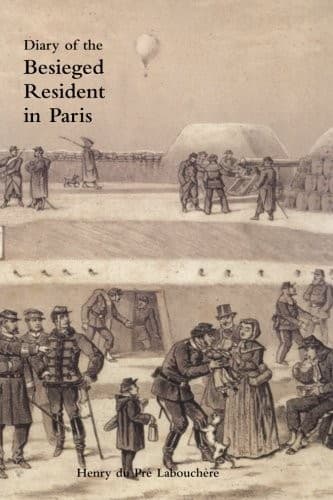
Diary of the Besieged Resident in ParisLabouchere, Henry Du Pré
History
Diary of the Besieged Resident in Paris
Labouchere, Henry Du Pré
Franco-Prussian War, 1870-1871; Paris (France) -- History -- Siege, 1870-1871 -- Personal narratives
General Bellemare has been suspended. He, it appears, is to be the
scapegoat of the Bourget affair. I hear from the Quartier-General that
the real reason why the artillery did not arrive in time to hold this
position was, not because Bellemare did not ask for it, but because he
could not get it. Red tape and routine played their old game. From St.
Denis none could be sent, because St. Denis is within the "territorial
defence of Paris," and Bourget is not. In vain Bellemare's officers went
here and there. They were sent from pillar to post, from one aged
General to another, and at eleven o'clock on the day when Bourget was
taken, after the troops had been driven out of it, the artillery, every
formality having been gone through, was on its way to the village. It is
pleasant, whilst one is cut off from the outer world, to be reminded by
these little traits of one's native land, its War-Office and its
Horse-Guards.
I was out yesterday afternoon along our southern advanced posts. A few
stray shots were occasionally fired by Francs-tireurs; but there seemed
to be a tacit understanding that no offensive operations should take
place. The fall of the leaves enables us to distinguish clearly the
earthworks and the redoubts which the Prussians have thrown up. I am not
a military man, but my civilian mind cannot comprehend why Vanves and
Montrouge do not destroy with their fire the houses occupied on the
plateau of Chatillon by the Prussians. I asked an officer, who was
standing before Vanves, why they did not. He shrugged his shoulders, and
said, "It is part of the plan, I suppose." Trochu is respected by the
troops, but they have little confidence in his skill as a commander. In
the evening I went to the Club Rue d'Arras, which is presided over by
the "venerable" Blanqui in person, and where the Ultras of the Ultras
congregate. The club is a large square room, with a gallery at one end
and a long tribune at the other. On entering through a baize door one is
called upon to contribute a few sous to the fund for making cannon. When
I got there it was about 8.30. The venerable Blanqui was seated at a
table on the tribune; before him were two assessors. One an unwholesome
citizen, with long blond hair hanging down his back, the other a most
truculent-looking ruffian. The hall was nearly full; many were in
blouses, the rest in uniform; about one-fifth of the audience was
composed of women, who either knitted, or nourished the infants, which
they held in their arms. A citizen was speaking. He held a list in his
hand of a new Government. As he read out the names some were applauded,
others rejected. I had found a place on a bench by the side of a lady
with a baby, who was occupied, like most of the other babies, in taking
its supper. Its food, however, apparently did not agree with it, for it
commenced to squall lustily. "Silence," roared a hundred voices, but the
baby only yelled the louder. "Sit upon it," observed some energetic
Public-domain text, read in full here on John Shaqi.
Reviews
Reviews
No reviews yet
Be the first to share your thoughts on this work.
Elsewhere in the archive
Join the Discussion
Join the discussion
Sign in to leave a comment or review.
Sign InorCreate an account