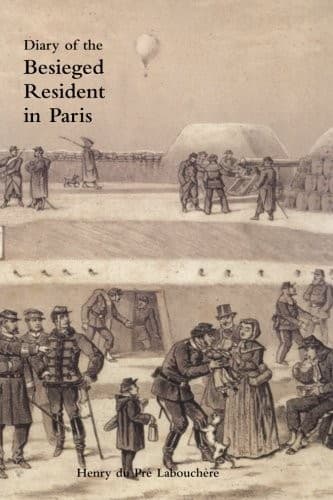
Diary of the Besieged Resident in ParisLabouchere, Henry Du Pré
History
Diary of the Besieged Resident in Paris
Labouchere, Henry Du Pré
Franco-Prussian War, 1870-1871; Paris (France) -- History -- Siege, 1870-1871 -- Personal narratives
I suppose that you in England know a good deal more of what is passing
at the Prussian headquarters than we do here. M. Jules Favre's departure
was kept so close a secret, that it did not ooze out until yesterday.
The "ultras" in the Government were, I understand on good authority,
opposed to it, but M. Jules Favre was supported by Picard, Gambetta, and
Keratry, who, as everything is comparative, represent the moderate
section of our rulers. We are as belligerent and cheery to-day as we
were despondent on Monday evening. When any disaster occurs it takes a
Frenchman about twenty-four hours to accustom himself to it. During this
time he is capable of any act of folly or despair. Then follows the
reaction, and he becomes again a brave man. When it was heard that the
heights at Meudon had been taken, we immediately entered into a phase of
despair. It is over now, and we crow as lustily as ever. We shall have
another phase of despondency when the first fort is taken, and another
when the first shells fall into the town; but if we get through them, I
really have hopes that Paris will not disgrace herself. Nothing of any
importance appears to have taken place at the front yesterday. The
commanders of several forts sent to Trochu to say that they have fired
on the Prussians, and that there have been small outpost engagements.
During the day the bridges of St. Cloud, Sevres, and Billancourt were
blown up. I attempted this morning to obtain a pass from General Trochu.
Announcing myself as a "Journaliste Anglais," I got, after some
difficulty, into a room in which several of his staff were seated. But
there my progress was stopped. I was told that aides-de-camp had been
fired on, and that General Trochu had himself been arrested, and had
been within an inch of being shot because he had had the impudence to
say that he was the Governor of Paris. I suggested that he might take me
with him the next time he went out, and pointed out that correspondents
rode with the Prussian staffs, but it was of no use. From Trochu I went
to make a few calls. I found every one engaged in measuring the distance
from the Prussian batteries to his particular house. One friend I found
seated in a cellar with a quantity of mattresses over it, to make it
bomb-proof. He emerged from his subterraneous Patmos to talk to me,
ordered his servant to pile on a few more mattresses, and then
retreated. Anything so dull as existence here it is difficult to
imagine. Before the day is out one gets sick and tired of the one single
topic of conversation. We are like the people at Cremorne waiting for
the fireworks to begin; and I really do believe that if this continues
much longer, the most cowardly will welcome the bombs as a relief from
the oppressive ennui. Few regiments are seen now during the day marching
through the streets--they are most of them either on the ramparts or
outside them. From 8 to 9 in the morning there is a military movement,
as regiments come and go, on and off duty.
Public-domain text, read in full here on John Shaqi.
Reviews
Reviews
No reviews yet
Be the first to share your thoughts on this work.
Join the Discussion
Join the discussion
Sign in to leave a comment or review.
Sign InorCreate an account