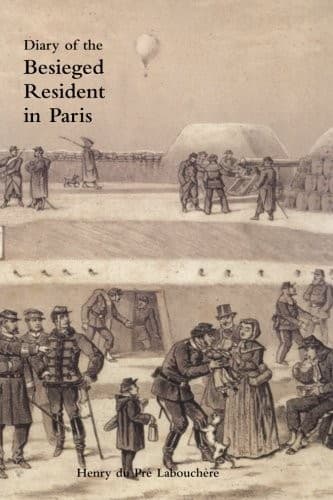
Diary of the Besieged Resident in ParisLabouchere, Henry Du Pré
History
Diary of the Besieged Resident in Paris
Labouchere, Henry Du Pré
Franco-Prussian War, 1870-1871; Paris (France) -- History -- Siege, 1870-1871 -- Personal narratives
We have passed from the lowest depths of despair to the wildest
confidence. Yesterday afternoon a pigeon arrived covered with blood,
bearing on its tail a despatch from Gambetta, of the 11th, announcing
that the Prussians had been driven out of Orleans after two days'
fighting, that 1,000 prisoners, two cannon, and many munition waggons
had been taken, and that the pursuit was still continuing. The despatch
was read at the Mairies to large crowds, and in the _cafes_ by
enthusiasts, who got upon the tables. I was in a shop when a person came
in with it. Shopkeeper, assistants, and customers immediately performed
a war dance round a stove; one would have supposed that the war was over
and that the veracity of Gambetta is unimpeachable. But as though this
success were not enough in itself, all the newspapers this morning tell
us that "Chartres has also been retaken," that the army of Keratry has
effected a junction with that of the Loire, and that in the North
Bourbaki has forced the Prussians to raise the siege of Amiens. Everyone
is asking when "they" will be here. Edmond About, in the _Soir_, eats
dirt for having a few days ago suggested an armistice.
At the Quartier-General I do not think that very great importance is
attached to Gambetta's despatch, except as an evidence that the
provinces are not perfectly apathetic. It is considered that very
possibly the Prussians may have concentrated their whole available force
round Paris, in order to crush our grand sortie when it takes place.
General Trochu himself takes the most despondent view of the situation,
and bitterly complains of the "spirit" of the army, the Mobiles, and the
Parisians. This extraordinary commander imagines that he will infuse a
new courage in his troops by going about like a monk of La Trappe,
saying to every one, "Brother, we must die."
Public-domain text, read in full here on John Shaqi.
Reviews
Reviews
No reviews yet
Be the first to share your thoughts on this work.
Elsewhere in the archive
Join the Discussion
Join the discussion
Sign in to leave a comment or review.
Sign InorCreate an account