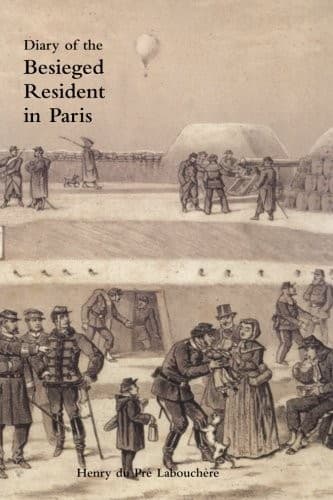
Diary of the Besieged Resident in ParisLabouchere, Henry Du Pré
History
Diary of the Besieged Resident in Paris
Labouchere, Henry Du Pré
Franco-Prussian War, 1870-1871; Paris (France) -- History -- Siege, 1870-1871 -- Personal narratives
The ambulances were ordered out this morning, and at seven o'clock some
300 victims rendezvoused with the carriages on the Quai, near the Place
de la Concorde. After freezing there for about two hours, it was
suggested that a messenger should be sent to General Trochu, to ask him
whether we were really wanted. The reply was that no attack would be
made to-day, and consequently we went off home to thaw. If wars really
must be made, I do hope that we shall fall back upon the old system of
carrying on military operations in summer. When the thermometer is below
zero, I feel like Bob Acres--all my valour oozing out at my fingers'
ends. The doctors tell me that many slight wounds have gangrened owing
to the cold. When a battle lasts until evening the mass of the wounded
cannot be picked up until the next morning, and their sufferings during
the night must be terrible. I saw several poor fellows picked up who
appeared literally frozen.
The _Journal Officiel_ of to-day contains a letter from Monseigneur
Bauer, protesting against the Prussians having shot at him when he went
forward with a flag of truce and a trompette. The fact is vouched for
by, among others, a journalist who remained during the night of Friday
outside the walls. I can easily believe it, for the Prussians are not a
chivalrous enemy. They are perpetually firing on ambulances: and, when
it suits their own purposes, raising the white flag. If, indeed,
one-tenth part of the stories which I hear of their treacheries be true,
they ought to be exterminated like wolves. This Monseigneur Bauer is a
character. He began life as a German Jew, and he is now a Frenchman and
a Christian Bishop. During the Empire he was chaplain to the court, and
confessor of the Empress. He is now chaplain of the Ambulances de la
Presse, and has under his orders 800 "Freres Chretiens," who dress as
priests, but are not in holy orders. Both he and they display the
greatest courage. The Freres Chretiens are the foremost in picking up
the wounded; going forward long before the firing is over. The Bishop
prances about on his horse, dressed in a soutane and long boots, the
Grand Cross of the Legion of Honour on his breast, a golden crucifix
hanging from his neck, and a huge episcopal ring on his finger, outside
his gloves. Sometimes he appears in a red cloak, which, I presume, is a
part of his sacerdotal gear. I am told, by those who know him, that
"Monseigneur" is a consummate humbug, but he is very popular with the
soldiers, as he talks to them in their own language, and there certainly
is no humbug about his pluck. He is as steady under fire as if he were
in a pulpit. He was by the side of Ducrot when the general's horse was
killed under him.
Public-domain text, read in full here on John Shaqi.
Reviews
Reviews
No reviews yet
Be the first to share your thoughts on this work.
Elsewhere in the archive
Join the Discussion
Join the discussion
Sign in to leave a comment or review.
Sign InorCreate an account