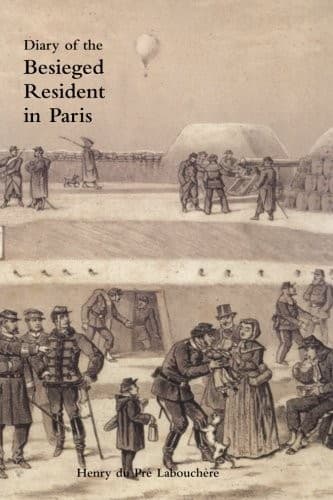
Diary of the Besieged Resident in ParisLabouchere, Henry Du Pré
History
Diary of the Besieged Resident in Paris
Labouchere, Henry Du Pré
Franco-Prussian War, 1870-1871; Paris (France) -- History -- Siege, 1870-1871 -- Personal narratives
The events of the past week prove that General Trochu's sole available
force for resisting the enemy consists of the Line and the Mobiles. As
for the population of Paris, they are more than useless. They eat up the
provisions; they are endowed with a mixture of obstinacy and conceit,
which will very probably enable them to endure considerable hardships
rather than surrender; fight, however, they will not, although I am
convinced that, to the end of their lives, they will boast of their
heroic valour, and in the legend which will pass muster as history of
the siege of Paris, our grandchildren will be taught that in 1870, when
the French troops were all prisoners of war, the citizens of the French
capital "covered themselves with honour," and for nearly three months
held their town against the furious onslaughts of the victorious German
armies. The poor soldiers and the Mobiles, who do all the real fighting,
will experience the eternal truth of Virgil's _Sic vos non vobis_. But
there is no use being angry at what will happen in one hundred years,
for what does it signify to any who are now alive either in Paris or out
of Paris?
_December 5th._
A proclamation has been issued by the Government, announcing that the
troops have retired across the Marne, as the enemy has had time to
collect such a force in front of Villiers and Champigny, that further
efforts in this direction would be sterile. "The loss of the enemy
during the glorious days of the 29th and 30th November, and December
2nd, has been so great that, struck down in its pride of power, it has
allowed an army which it attacked the day before, to cross a river under
its eyes, and in the light of day," continues this manifesto. Now,
considering that the crossing took place at Joinville, and that the
river at that point is under the fire of three forts and two redoubts,
it appears to me that General Trochu might as well take credit to
himself for crossing the Seine opposite the Place de la Concorde. I will
say for the Government of to-day, that in any attempt to beat its
predecessor in mendacity it had a hard task, but it has worked with a
will, and completely succeeded. The military attaches who are still
here, consider that the French loss during the three days cannot be less
than 10,000 in killed and wounded. It is very unlikely that the
Government will admit a loss of above 2,000 or 3,000. That of the
Prussians is, we are told, far larger than ours. Without accepting this
assertion as gospel, it must have been very heavy. A friend of mine
himself counted 500 dead bodies in one wood. We have a certain number of
prisoners. With respect to the wounded Germans in our hands, I find that
there are about 30 in my hotel, as against above 400 French. In the
American ambulance, out of 130 only two are Germans. Colonel Claremont,
who had put off his departure, witnessed the fight in the redoubt which
General Fave had built opposite Joinville. He was nearly killed several
Public-domain text, read in full here on John Shaqi.
Reviews
Reviews
No reviews yet
Be the first to share your thoughts on this work.
Elsewhere in the archive
Join the Discussion
Join the discussion
Sign in to leave a comment or review.
Sign InorCreate an account