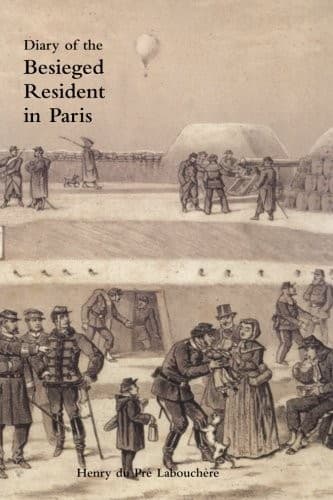
Diary of the Besieged Resident in ParisLabouchere, Henry Du Pré
History
Diary of the Besieged Resident in Paris
Labouchere, Henry Du Pré
Franco-Prussian War, 1870-1871; Paris (France) -- History -- Siege, 1870-1871 -- Personal narratives
times by bombs from La Faisanderie, which was behind him, bursting
short.
The Parisians are somewhat taken aback at the victory resulting in a
retreat. They appear, however, to be as ignorant of the environs of
their own capital as they are of foreign countries, and they never
condescend to consult a map. While some of them shake their heads in
despair of success, the majority are under the impression that Villiers
and Champigny are far beyond the range of the guns of our forts, and
that as the ground near them is still occupied by our troops, something
which will lead to the speedy retreat of the Prussians has been done. We
are two millions, they say; we will all die rather than surrender: and
they appear to be under the impression that if they only say this often
enough, Paris never will be taken. The Ultra-Democrats in the clubs have
a new theory to account for their refusal to fight. "We are," observed
an orator, a few nights ago, "the children of Paris, she has need of us;
can we leave her at such a moment?" Some of these heroes, indeed, assert
that the best plan would be to allow the Prussians to enter and then
convert them to the doctrines of Republicanism. I think it was St.
Augustine who did not despair of the devil eventually turning over a new
leaf; in the same way I heard an ardent patriot express the hope of
being able to convert "William" himself to the creed of the Universal
Republic. At the club where these fraternal sentiments were expressed
there is a lady who sits on the platform. When anyone makes what she
considers a good speech she embraces him on both cheeks. She is by no
means ugly, and I had serious thoughts of making a few observations
myself in view of the reward. That bashfulness, however, which has been
my bane through life, prevented me. The lady occasionally speaks
herself, and is fond of giving her own experiences. "I was on my way to
this club," she said, "the other evening, when I observed a man
following me. 'What dost thou want?' I asked, sternly eyeing him. 'I
love you,' replied the vile aristocrat. 'I am the wife of a citizen,' I
answered, 'and the mother of the Gracchi.' The wretch sneaked away,
abashed to seek other prey. If he addresses himself to some princess or
duchess he will probably find a victim." The loudest applause greeted
this "experience," and several very unclean-looking patriots rushed
forward to embrace the mother of the Gracchi, in order to show her how
highly they appreciated her noble conduct.
Public-domain text, read in full here on John Shaqi.
Reviews
Reviews
No reviews yet
Be the first to share your thoughts on this work.
Elsewhere in the archive
Join the Discussion
Join the discussion
Sign in to leave a comment or review.
Sign InorCreate an account