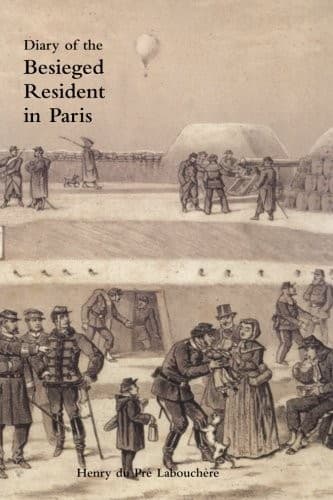
Diary of the Besieged Resident in ParisLabouchere, Henry Du Pré
History
Diary of the Besieged Resident in Paris
Labouchere, Henry Du Pré
Franco-Prussian War, 1870-1871; Paris (France) -- History -- Siege, 1870-1871 -- Personal narratives
A fresh order was issued yesterday, suppressing all passes until further
notice. I have a pass _en regle_ from General Vinoy; but even with this,
the last time I went out of the town I was turned back at two gates
before I got through at the third. A good deal of discussion has taken
place among the foreign correspondents respecting the fairness of going
out with an ambulance under guise of the Geneva flag. I see myself no
objection to it, provided the correspondent really does make himself
useful in picking up the wounded. In the Prussian camp a correspondent
has a recognised position; here it is different, and he must use all
legitimate means to obtain intelligence of what is passing. My pass, for
instance, does not describe me as a correspondent, but as an Englishman
accredited by the British Embassy. At the commencement of the siege I
begged Mr. Wodehouse to give me a letter of introduction to M. Jules
Ferry, one of the members of the Government. This I did not deliver, but
at General Vinoy's headquarters I showed it to prove that I was not a
Prussian spy, but that I was known by my natural guardian. An
aide-de-camp then gave me a pass, and, not knowing precisely what to
call me, described me as "accredited by the British Embassy." I move
about, therefore, as a mysterious being--perhaps an Ambassador, perhaps
an Ambassador's valet. A friend of mine, who is an authority with the
Ambulance de la Presse, and who owns a carriage, has promised to call
for me when next the ambulances are sent for; but, as I have already
said, all my energy oozes out of me when the thermometer is below zero;
and unless the next battle is fought on a warm day, I shall not witness
it. As a matter of fact, unless one is riding with the staff of the
general who commands, one cannot form an idea of what is going on by
hanging about, and it is a horrible sight to look with an opera-glass at
men and horses being massacred. When knights charged each other with
lances there was a certain chivalry in war; but there is nothing either
noble or inspiriting in watching a quantity of unfortunate Breton
peasants, who cannot even speak French, and an equal number of Berlin
grocers, who probably ask for nothing better than to be back in their
shops, destroying each other at a distance of two or three miles with
balls of lead and iron, many of them filled with explosive materials. I
confess that I pity the horses almost as much as the men. It seems a
monstrous thing that in order that the Alsacians should be forced into
becoming subjects of King William of Prussia, an omnibus horse, who has
honestly done his work in the streets of Paris, should be taken outside
the walls of the town to have his head blown off or to stump about on
three legs until he dies of cold and hunger. Horses have a way when they
are wounded of making desperate efforts to get up, and then letting
their heads fall with a bang on the soil which is very horrible to
witness.
Public-domain text, read in full here on John Shaqi.
Reviews
Reviews
No reviews yet
Be the first to share your thoughts on this work.
Elsewhere in the archive
Join the Discussion
Join the discussion
Sign in to leave a comment or review.
Sign InorCreate an account