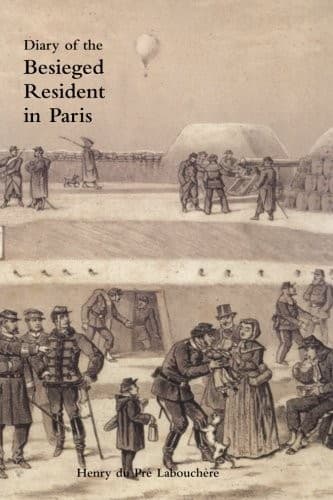
Diary of the Besieged Resident in ParisLabouchere, Henry Du Pré
History
Diary of the Besieged Resident in Paris
Labouchere, Henry Du Pré
Franco-Prussian War, 1870-1871; Paris (France) -- History -- Siege, 1870-1871 -- Personal narratives
Everybody in authority and out of it seems to have a different opinion
as to when the siege will end. I cannot think that when a town with two
million inhabitants is reduced to such expedients as this is now, it can
hold out very long. The rations, consisting alternately of horse and
salt fish, are still distributed, but they are hardly sufficient to keep
body and soul together. Unless we make up our minds to kill our
artillery horses, we shall soon come to the end of our supply. The
rumour to-day is that the Prussians have evacuated Versailles, and that
Frederick Charles has been beaten in a battle on the Loire, but I cannot
say that I attach great credit to either story. No pigeon has arrived
for the last three days, owing, it is supposed, to the cold; and until
we know for certain what d'Aurelles de Paladine is doing, we are unable
to form an accurate opinion of the chances of the siege being raised.
All that can be said is that, left to ourselves, we shall not be able to
break through the lines of investment, and that when we have eaten up
all our food, we shall have to capitulate.
_December 7th._
When this war commenced the Parisians believed in the bulletins which
their own Government issued, because they thought it only natural that
their arms should be successful, and they disbelieved in any foreign
newspaper which ventured to contest their victories. At present they are
incredulous alike of everything that comes from friend and foe.
Nine-tenths of them are under the impression that Count Moltke, in
announcing the defeat of the Army of the Loire, is guilty of a
deliberate falsehood; the other tenth supposes that he has grossly
exaggerated a slight mishap, and that the occupation of Orleans only
proves that Orleans was not defended by a large body of troops. It takes
about three days for any information which is not in accordance with the
wishes of this extraordinary population to obtain credit, no matter what
amount of evidence there may be to prove its truth. If really the Army
of the Loire has been put _hors de combat_, sooner or later the fact
will be admitted; then, although we shall still pin our faith to Keratry
or Bourbaki, the disaster will no doubt tend to produce a certain
degree of discouragement, more particularly as it is coupled with the
retreat of Ducrot's forces from the south bank of the Marne. French
politicians will insist upon dressing up their facts in order to meet
the requirements of the moment, and they never seem to consider that so
soon as the real state of things comes out there must be an inevitable
reaction, which will be far more depressing than if the truth had been
fairly told at once. I hear that when Count Moltke's letter arrived, two
of the members of the Government of National Defence were inclined to
accept his offer to verify what had occurred on the Loire, but that
General Trochu stated that he intended to resist until the last, and
Public-domain text, read in full here on John Shaqi.
Reviews
Reviews
No reviews yet
Be the first to share your thoughts on this work.
Elsewhere in the archive
Join the Discussion
Join the discussion
Sign in to leave a comment or review.
Sign InorCreate an account