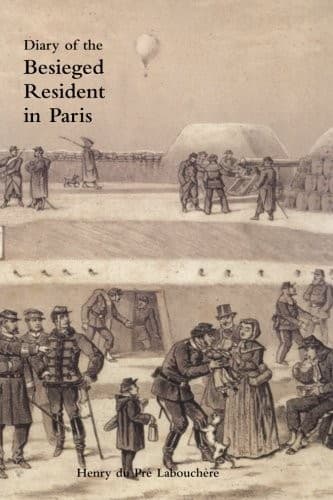
Diary of the Besieged Resident in ParisLabouchere, Henry Du Pré
History
Diary of the Besieged Resident in Paris
Labouchere, Henry Du Pré
Franco-Prussian War, 1870-1871; Paris (France) -- History -- Siege, 1870-1871 -- Personal narratives
I trust that England never will be invaded. But if it is, we shall do
well to profit by the experience of what is occurring here. There must
be no English force, half citizen half soldier. All who take part in the
national defence must submit to the strict discipline of soldiers. A
vast amount of money has been laid out in equipping the National Guard.
Their pay alone amounts to above 20,000fr. per diem, and, as far as the
defence of Paris is concerned, they might as well have remained quietly
by their own firesides. There are, no doubt, brave men among them, but
as their battalions insist upon being regarded as citizens even when
under arms, they have no discipline, and are little better than an armed
mob. The following extract from an article in the last number of the
_Revue des Deux Mondes_ gives some interesting details respecting their
habits when on duty behind that most useless of all works of defence,
the line of the Paris fortifications:--"On the arrival of a battalion,
the chief of the post arranges the hours during which each man is to be
on active duty. After this, the men occupy themselves as they please.
Some play at interminable games of _bouchon_; others, notwithstanding
orders to the contrary, turn their attention to ecarte and piquet;
others gossip over the news of the day with the artillerymen, who are
keeping guard by the side of their cannon. Some go away on leave, or
disappear without leave; they make excursions beyond the ramparts, or
shut themselves up in the billiard-room of some cafe. Many make during
the course of the day frequent visits to the innumerable canteens, which
succeed each other almost without interruption along the Rue des
Ramparts. Here old women have lit a few sticks under a pot, and sell,
for a penny the glass, a horrible brew called 'petit noir,' composed of
sugar, eau de vie, and the grains of coffee, boiled up together. Behind
there is a line of cook shops, the proprietors of which announce that
they have been commissioned to provide food. These speculators offer for
sale greasy soup, slices of horse, and every species of alcoholic drink.
Each company has, too, its cantiniere, and round her cart there is
always a crowd. It seldom happens that more than one-half of the men of
the battalion are sober. Fortunately, the cold of the night air sobers
them. Between eight and nine in the evening there is a gathering in the
tent. A circle is formed in it round a single candle, and whilst the
flasks go round tale succeeds to song, and song to tale, until at length
all fall asleep, and are only interrupted in their slumbers until
morning by the corporal, who, once every hour, enters and calls out the
names of those who are to go on the watch. The abuse of strong drink
makes shameful ravages in our ranks, and is productive of serious
disorder. Few nights pass without false alarms, without shots foolishly
fired upon imaginary enemies, and without lamentable accidents. Every
Public-domain text, read in full here on John Shaqi.
Reviews
Reviews
No reviews yet
Be the first to share your thoughts on this work.
Elsewhere in the archive
Join the Discussion
Join the discussion
Sign in to leave a comment or review.
Sign InorCreate an account