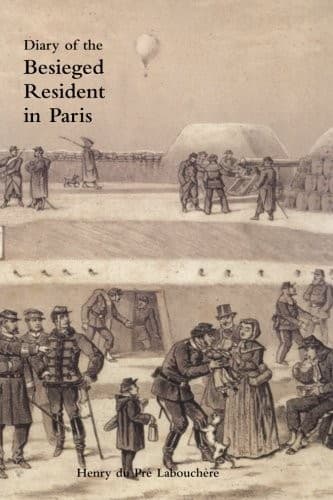
Diary of the Besieged Resident in ParisLabouchere, Henry Du Pré
History
Diary of the Besieged Resident in Paris
Labouchere, Henry Du Pré
Franco-Prussian War, 1870-1871; Paris (France) -- History -- Siege, 1870-1871 -- Personal narratives
When the Fenians in the United States meditate a raid upon Canada, they
usually take very great care to allow their intentions to be known. Our
sorties are much like these Hibernian surprises. If the Prussians do not
know when we are about to attack, they cannot complain that it is our
fault. The "Apres vous, Messieurs les Anglais," still forms the
chivalrous but somewhat naif tactics of the Gauls. On Sunday, as a first
step to military operations, the gates of the city were closed to all
unprovided with passes. On Monday a grand council of generals and
admirals took place at the Palais Royal. Yesterday, and all last night,
drums were beating, trumpets were blowing, and troops were marching
through the streets. The war battalions of the National Guard, in their
new uniforms, spick and span, were greeted with shouts, to which they
replied by singing a song, the chorus of which is "Vive la guerre,
Piff-Paff," and which has replaced the "Marseillaise." As the ambulances
had been ordered to be ready to start at six in the morning, I presumed
that business would commence at an early hour, and I ordered myself to
be called at 5.30. I was called, and got out of my bed, but, alas for
noble resolutions! having done so, I got back again into it and remained
between the sheets quietly enjoying that sleep which is derived from the
possession of a good conscience, and a still better digestion, until the
clock struck nine.
It was not until past eleven o'clock that I found myself on the outside
of the gate of La Villette, advancing, as Grouchy should have done at
Waterloo, in the direction of the sound of the cannon. From the gate a
straight road runs to Le Bourget, having the Fort of Aubervilliers on
the right, and St. Denis on the left. Between the fort and the gate
there were several hundred ambulance waggons, and above a thousand
"brancardiers," stamping their feet and blowing on their fingers to keep
themselves warm. In the fields on each side of the road there were
numerous regiments of Mobiles drawn up ready to advance if required. Le
Bourget, everyone said, had been taken in the morning, our artillery was
on ahead, and we were carrying everything before us, so towards Le
Bourget I advanced. About a mile from Le Bourget, there is a cross-road
running to St. Denis through Courneuve. Here I found the barricade which
had formed our most advanced post removed. Le Bourget seemed to be on
fire. Shells were falling into it from the Prussian batteries, and, as
well as I could make out, our forts were shelling it too. Our artillery
was on a slight rise to the right of Le Bourget, in advance of Drancy;
and in the fields between Drancy and this rise, heavy masses of troops
were drawn up in support. Officers assured me that Le Bourget was still
in our possession, and that if I felt inclined to go there, there was
nothing to prevent me. I confess I am not one of those persons who snuff
up the battle from afar, and feel an irresistible desire to rush into
Public-domain text, read in full here on John Shaqi.
Reviews
Reviews
No reviews yet
Be the first to share your thoughts on this work.
Elsewhere in the archive
Join the Discussion
Join the discussion
Sign in to leave a comment or review.
Sign InorCreate an account