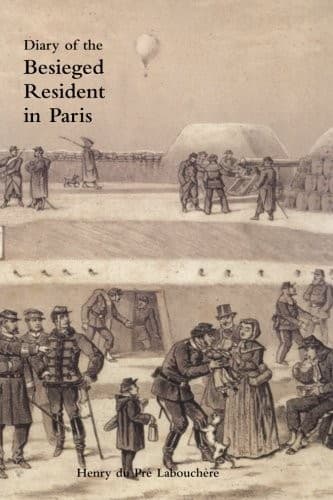
Diary of the Besieged Resident in ParisLabouchere, Henry Du Pré
History
Diary of the Besieged Resident in Paris
Labouchere, Henry Du Pré
Franco-Prussian War, 1870-1871; Paris (France) -- History -- Siege, 1870-1871 -- Personal narratives
the middle of it. To be knocked on the head by a shell, merely to
gratify one's curiosity, appears to me to be the utmost height of
absurdity. Those who put themselves between the hammer and the anvil,
come off generally second best, and I determined to defer my visit to
the interesting village before me until the question whether it was to
belong to Gaul or Teuton had been definitely decided. So I turned off to
the left and went to St. Denis.
Here everybody was in the streets, asking everybody else for news. The
forts all round it were firing heavily. On the Place before the
Cathedral there was a great crowd of men, women, and children. The
sailors, who are quartered here in great numbers, said that they had
carried Le Bourget early in the morning, but that they had been obliged
to fall back, with the loss of about a third of their number. Most of
them had hatchets by their sides, and they attack a position much as if
they were boarding a ship. About 100 prisoners had been brought into the
town in the morning, as well as two Freres Chretiens, who had been
wounded, and for whom the greatest sympathy was expressed. Little seemed
to be known of what was passing. "The Prussians will be here in an
hour," shouted one man; "The Prussians are being exterminated," shouted
another. "What is this?" cried the crowd, as Monseigneur Bauer, the
bishop _in partibus infidelium_ of some place or other, now came riding
along with his staff. He held up his two fingers, and turned his hand
right and left. His pastoral blessing was, however, but a half success.
The women crossed themselves, and the men muttered "farceur." The war
which is now raging has produced many oddities, but none to my mind
equal to this bishop. His great object is to see and be seen, and most
thoroughly does he succeed in his object. He is a short, stout man,
dressed in a cassock, a pair of jack-boots with large spurs, and a hat
such as you would only see at the opera. On his breast he wears a huge
star. Round his neck is a chain, with a great golden cross attached to
it; and on his fingers, over his gloves, he wears gorgeous rings. The
trappings of his horse are thickly sprinkled with Geneva crosses. By his
side rides a standard-bearer, bearing aloft a flag with a red cross.
Eight aides-de-camp, arrayed in a sort of purple and gold fancy uniform,
follow him, and the _cortege_ is closed by two grooms in unimpeachable
tops. In this guise, and followed by this etat major, he is a
conspicuous figure upon a field of battle, and produces much the same
effect as the head of a circus riding into a town on a piebald horse,
surrounded by clowns and pets of the ballet. He was the confessor of the
Empress, and is now the aumonier of the Press; but why he wears
jack-boots, why he capers about on a fiery horse, why he has a staff of
aides-de-camp, and why he has two grooms, are things which no one seems
to know. He patronises generals and admirals, doctors and commissariat
Public-domain text, read in full here on John Shaqi.
Reviews
Reviews
No reviews yet
Be the first to share your thoughts on this work.
Elsewhere in the archive
Join the Discussion
Join the discussion
Sign in to leave a comment or review.
Sign InorCreate an account