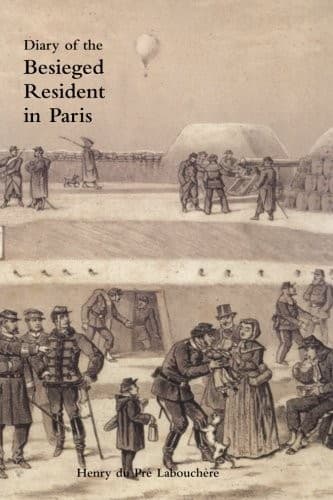
Diary of the Besieged Resident in ParisLabouchere, Henry Du Pré
History
Diary of the Besieged Resident in Paris
Labouchere, Henry Du Pré
Franco-Prussian War, 1870-1871; Paris (France) -- History -- Siege, 1870-1871 -- Personal narratives
preparations for a retreat were hurriedly made. The guns were taken from
their carriages, the baggage was laden on the carts, and the munition on
the waggons. The soldiers strapped on their knapsacks, struck their
tents, and harnessed the horses. All this was not accomplished without
difficulty, for it had to be done noiselessly and in the dark, for all
the fires had been put out. General Trochu, seated on a horse, issued
his directions, and every moment received information of what was taking
place. Notwithstanding the expostulations of his staff, the General
refused to withdraw from this exposed point. 'No, gentlemen,' he said,
'I shall not withdraw from here until the cannon are in safety.' At two
in the morning all was ready; the long train began to move; the cannon
of 7 and the mitrailleuses of Commandant Pothier took the lead. Then
followed the heavy naval guns, then the munition and baggage waggons;
the troops of the Line, the Marines, and the National Guard were ordered
to cover the retreat. It was no easy matter to descend from the plateau
to Rosny. The frost had made the road a literal ice-hill. The drivers
walked by the side of their animals, holding the reins and pulling them
up when they stumbled. Until four o'clock, however, everything went
well. The march slowly continued, and the Prussian batteries were
comparatively calm. Their shells fell still occasionally where our guns
had been. The noise of the wheels, however, and the absence of all
cannonade on our parts, at length awakened the suspicions of the enemy.
Their fire was now directed on the fort of Rosny, and the road from the
plateau leading to it. At this moment the line of guns and waggons was
passing through the village, and only carts with baggage were still on
the plateau. At first the shells fell wide; then they killed some
horses; some of the drivers were hit; a certain confusion took place.
That portion of our line of march which was in Rosny was in imminent
danger. Fortunately, our chiefs did not lose their heads. The guns whose
horses were untouched passed those which were obliged to stop. Some of
them took to the fields; the men pushed the wheels, and, thanks to their
efforts, our artillery was saved. As soon as the guns had been dragged
up the hill opposite the plateau, the horses started off at a gallop,
and did not stop until they were out of the range of the enemy's fire.
The guns were soon in safety at Vincennes and Montreuil. The troops held
good, the men lying down on their stomachs, the officers standing up and
smoking their cigars until the last waggon had passed. Day had broken
when they received orders to withdraw. The National Guard went back
into Paris, and the Line, after a short halt at Montreuil, camped in the
barracks of St. Maur. At eight o'clock, the evacuation of the plateau
was complete; but the Prussian shells still fell upon the deserted
houses and some of the gun-carriages which had been abandoned. The enemy
Public-domain text, read in full here on John Shaqi.
Reviews
Reviews
No reviews yet
Be the first to share your thoughts on this work.
Elsewhere in the archive
Join the Discussion
Join the discussion
Sign in to leave a comment or review.
Sign InorCreate an account